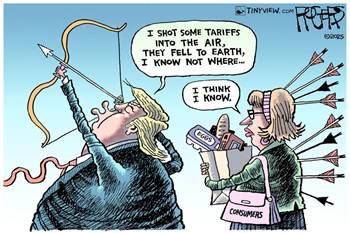
Understanding the MAGA Platform

THE ECONOMIC IMPACT OF AMERICA FIRST POLICIES

“MAGA” — shorthand for Make America Great Again — isn’t a single policy platform so much as a cluster of political goals and instincts that coalesced around Donald Trump. If you strip away the slogans, a few core aims show up consistently.

1. Economic nationalism
A central goal is to prioritize domestic industry over global integration. That means tariffs, skepticism of free trade agreements, and efforts to bring manufacturing back to the U.S. The theory is simple: protect American jobs even if it disrupts global supply chains. This disruption often leads to higher prices.

2. Restrictionist immigration policy
MAGA emphasizes tighter border control, reduced legal immigration in some cases, and aggressive enforcement (ICE enforcement policies). The underlying argument is that sovereignty and labor market stability depend on controlling who enters the country.

3. Strong executive power
There’s a clear preference for a more assertive presidency.  Using executive authority to push policy when Congress stalls is the strategy. Supporters see this as necessary to overcome gridlock. Critics see it as a threat to institutional checks and balances. The ultimate goal is authoritarian rule.

4. Cultural conservatism
MAGA places heavy emphasis on traditional national identity, patriotism, and resistance to social change. This often includes opposition to what supporters’ call “elite” or “woke” cultural norms in media, education, and government.  

5. Skepticism of institutions
A defining feature is distrust of established institutions. This includes federal agencies to mainstream media to international alliances. Organizations like NATO are sometimes framed as burdens unless they clearly serve U.S. interests.

6. “America First” foreign policy
Less focus on multiple country deals, more emphasis on bilateral deals and reducing long-term foreign entanglements. Although in practice this has been uneven, especially when strategic or economic interests are at stake.

7.  White Male Hierarchy

As policy evolves, people of color and women occupy a contested place within the worldview associated with Make America Great Again. Supporters argue the movement is fundamentally race- and gender-neutral. It simply emphasizes nationalism, economic opportunity, and traditional values over identity-based politics.  They point to growing (though still very limited) support among some Latino and Black voters and strong backing from many conservative women. But  its policy priorities and cultural framing—on immigration, voting access, reproductive rights, and opposition to diversity initiatives—tend to disproportionately affect people of color and constrain women’s autonomy.  This view elevates a narrower vision of national identity that aligns more closely with traditional white male hierarchies. The result is a tension at the core of the movement: it seeks broad-based populist appeal yet often advances policies and narratives that many women and minority communities experience as exclusionary and discriminatory.

The Reality Check
These goals don’t always fit neatly together. For example, economic nationalism can raise prices for consumers, and limiting immigration can strain industries that rely on labor. Likewise, skepticism of institutions can energize supporters but also weaken the very systems that keep government accountable.  Exclusion of women and people of color will often be the norm particularly in voting.

So MAGA isn’t just a policy agenda. It’s a worldview: one that prioritizes national sovereignty, cultural cohesion, and centralized political will. This view diminishes or eliminates our long-standing democratic norms and global systems.

The Real Cost of “America First”

“America First” sounds simple, even intuitive. But as Make America Great Again becomes policy, its effects are anything but simple. They show up not in speeches, but in grocery aisles, rent payments, hospital bills, and classrooms across places like Virginia.

Start with the basics: food and housing. Restricting immigration and imposing tariffs—policies central to the MAGA agenda—are meant to protect American workers. But they also reduce the labor supply in agriculture and construction while raising the cost of materials. The result is predictable: groceries inch upward, housing becomes more expensive to build, and rents follow. These aren’t abstract tradeoffs; they are weekly hits to household budgets.

Wages tell a more complicated story. Some workers, particularly in manufacturing or sectors facing labor shortages, may see modest gains. But for many Americans, those gains are swallowed by rising costs. Tariffs invite retaliation, squeezing export industries. Small businesses absorb higher input costs. The promise of economic nationalism collides with the reality of a deeply interconnected global economy, where pulling one lever rarely moves just one outcome.

Healthcare reveals an even sharper edge. Efforts to cut federal spending often target programs like Medicaid, shifting the burden to states and individuals. In practice, that means fewer covered families, more strain on rural hospitals, and higher out-of-pocket costs. For working- and middle-class Americans, the safety net doesn’t disappear overnight, it frays, slowly but steadily, until a single illness becomes a financial crisis.

Then there are the less visible, but equally consequential, shifts. In education, cultural priorities reshape curricula, restrict classroom discussions, and turn local school boards into ideological battlegrounds. In governance, an expanded reliance on executive power—hallmark of leadership under Donald Trump—means policies arrive quickly but rarely last. Regulations swing with each administration. Businesses hesitate. Families struggle to plan. Stability, the quiet foundation of economic security, erodes.

Supporters of this approach argue that tradeoffs are necessary—that higher prices or reduced services are the cost of reclaiming sovereignty, strengthening borders, and restoring cultural cohesion. Nations do make choices about identity and independence. But the question is not whether there are tradeoffs. It is who bears them, and when.

Right now, the burden falls disproportionately on ordinary Americans, and it arrives immediately—in higher bills, tighter services, and greater uncertainty. The promised benefits, by contrast, are longer-term and less certain. That imbalance is the core tension of the MAGA agenda: it asks households to absorb short-term pain for gains that may or may not materialize down the road. All the while, wealthy individuals enjoy huge tax breaks.

Public policy is ultimately a matter of priorities. If the goal is to strengthen American families, then success should be measured not by slogans or geopolitical posture, but by whether those families can afford their lives, access care, educate their children, and plan for the future with confidence. On that test, the results of “America First” are far more complicated—and far more costly—than its name suggests.  The hope is that it will end and our democracy will survive much like Hungary!

T. Michael Smith

wwwtmichaelsmith.com

(Heathercoxrichardson@substack.com April 19 post regarding the start of the American Revolution)

The 25th Amendment Is Not a Political Weapon

And That’s the Point

In moments of national anxiety, Americans reach for constitutional tools that promise swift accountability. Few are invoked as quickly—and as loosely—as the Twenty-fifth Amendment to the United States Constitution. Commentators, politicians, and partisans across the spectrum have treated it as a kind of emergency eject button for a president they believe is dangerous.

That’s a mistake. And it’s a dangerous one.

The 25th Amendment was not designed to settle political disputes or correct bad leadership. It exists for one reason: incapacity. Not unpopularity. Not recklessness. Not even abuse of power. Incapacity.

Understanding that distinction isn’t academic, it’s essential to preserving constitutional order.

A Mechanism Built for Crisis, Not Convenience

Section 4 of the amendment is the most dramatic and least understood provision. It lays out a process that is both swift and deliberately hard to sustain. If a president is unable to perform the duties of the office, the vice president and a majority of the Cabinet can declare that incapacity in writing. Power transfers immediately. The vice president becomes Acting President.

That’s the easy part.

What follows is a gauntlet designed to prevent abuse. The president can contest the declaration. If that happens, Congress must step in.  It takes a two-thirds vote in both chambers to keep the president sidelined.

In other words, Section 4 only works if there is overwhelming, bipartisan agreement that the president is genuinely unable to function.

That is not a bug. It’s the whole design.

What It Would Actually Look Like

Strip away the cable news speculation, and a real Section 4 scenario is stark and unsettling.

A president suffers a severe stroke. Or exhibits clear cognitive breakdown. This  would include confusion, inability to process basic information, or failure to respond during a national security emergency. Advisors notice first. Then the Cabinet. The vice president is forced into a decision no one seeks, whether to challenge the authority of the person who appointed them.

If they act, the transfer of power is immediate. Military command, intelligence briefings, executive authority—all shift to the vice president in an instant. Markets react. Allies call. Adversaries watch closely.

And then the fight begins.

The president, almost certainly, contests the move. Now Congress must decide—not in theory, but under pressure, in real time, with the stability of the government at stake. Within days, lawmakers must reach a supermajority consensus on a question that is as medical as it is political.  Is the president truly unable to do the job?

If the answer is anything short of overwhelming agreement, power snaps back to the president.

That’s how high the bar is. And it should be.

The Line We Keep Trying to Blur

In recent years—especially after the January 6 United States Capitol attack—calls to invoke Section 4 grew louder, particularly targeting Donald Trump. Many Americans, understandably alarmed, saw the amendment as a way to act quickly where other mechanisms seemed slow or uncertain.

But here’s the hard truth: even in that extraordinary moment, proving incapacity—not misconduct, not recklessness, but inability—would have been extraordinarily difficult.

And that’s because the amendment draws a bright, necessary line:

  • A president can make dangerous or unpopular decisions and still be capable.
  • A president can behave erratically and still be legally “able.”
  • A president can abuse power—and still not meet the threshold for removal under the 25th Amendment.

Those situations are addressed elsewhere in the Constitution—most notably through impeachment.

Conflating the two isn’t just sloppy thinking. It risks turning a medical and constitutional safeguard into a political weapon.

Why the Restraint Matters

If Section 4 were easy to invoke—or easier to sustain—it would invite constant use. Every period of divided government would carry the temptation to declare the president “unfit.” Every crisis would become a pretext.

The result wouldn’t be accountability. It would be instability.

The genius of the 25th Amendment is that it resists that temptation. It demands not just concern, but consensus. Not just suspicion, but evidence. Not just urgency, but certainty.

The Bottom Line

The 25th Amendment is a constitutional safety valve—but only for the most extreme scenarios. When a president is plainly unable to carry out the duties of the office does it apply.

It is not there to save us from bad leaders.
It is there to save the country from a leader who cannot function at all.

If we forget that—if we start treating incapacity as a matter of opinion rather than fact—we don’t just misuse the amendment.

We weaken the very system it was designed to protect.

T. Michael Smith  

wwwtmichaelsmith.com

CEASEFIRE

The newly brokered ceasefire between the United States and Iran is less a resolution than a pause in a rapidly escalating conflict. It is a two-week truce designed to halt immediate violence, reopen critical shipping lanes like the Strait of Hormuz, and create space for negotiations, not peace. Early signs already show how fragile it is.  Disagreement over whether the deal includes fighting in Lebanon, continued regional strikes, and competing interpretations of the terms all threaten to unravel it before diplomacy can take hold. Iran has signaled it still intends to assert strategic control in the region.  U.S. and allied leaders are scrambling to stabilize global shipping and prevent a wider war. In blunt terms, this ceasefire is not peace, it’s a high-stakes holding pattern where both sides are testing whether de-escalation is possible or simply the prelude to another round of conflict.

T. Michael Smith

wwwtmichaelsmith.com

Understanding the Price of War on American Budgets

WHAT ACTUALLY MATTERS?

The United States has entered another Middle East war with speed, force—and a striking lack of honesty about what it will cost. It is a terrible way to divert attention!

Not just in lives overseas, but in policy choices here at home.

But wars like this do not stay “over there.” They come back—in budgets, in alliances, and in the quiet trade-offs that reshape domestic priorities long after the headlines fade.

A Blank Check Meets a Tight Budget

Washington is already preparing to spend tens—if not hundreds—of billions to sustain military operations against Iran. That money will not magically appear.

It never does.

At the exact moment lawmakers are debating cuts to social programs, including pressure on Medicaid and other safety-net spending, this war opens a fiscal floodgate. The same political voices arguing that the country “cannot afford” healthcare expansion or poverty reduction somehow find limitless flexibility when it comes to war.

That contradiction isn’t new—but it is becoming harder to ignore. Listen people!! Do we want healthcare, education and poverty reduction or do we want WAR?

Every missile fired, every deployment extended, is a policy choice. And those choices are being made alongside proposals to constrain domestic investment in housing, healthcare, and economic stability.

You can call it national security. But it is also resource allocation. And right now, the balance is shifting—again—away from Americans at home.

Inflation, Energy, and the Hidden Tax of War

If Congress doesn’t make you feel the cost directly, the economy will.

As tensions disrupt oil flows through the Strait of Hormuz, global energy markets tighten. Prices rise. Supply chains strain.

For American families, that translates quickly:

  • Rising grocery bills
  • Increased borrowing costs
  • Higher Gas Prices

This is the hidden tax of war—one that doesn’t require a vote in Congress but lands just as forcefully in household budgets.

And it comes at a moment when affordability is already one of the central economic pressures in American life.

Executive Power, War Powers, and Accountability

There is also a constitutional cost.

The decision to engage in large-scale military action has once again stretched the limits of executive authority. Congress, constitutionally tasked with declaring war, has largely been sidelined.

This is not just a procedural concern. It is a democratic one.

When wars begin without clear authorization or sustained debate, accountability erodes. Objectives remain vague. Timelines blur. And the public is left reacting to events rather than shaping them.

If this conflict expands—and history suggests it might—the absence of clear legislative grounding will become more than a footnote. It will be a fault line. And we will have yet another mess.

NATO and the Strain on Alliances

Then there is the question of allies.

The North Atlantic Treaty Organization was built on the idea of collective defense and shared strategic purpose. But this war is testing that unity.

Some NATO members have offered support. Others are wary, concerned about escalation, legality, and the long-term consequences of another open-ended conflict in the Middle East.

That hesitation matters.

Because alliances are not just about military capability; they are about trust. When major actions are taken without broad alignment, that trust frays. And once frayed, it is difficult to rebuild.

At a time when global stability depends on coordinated responses—to Russia, to China, to economic shocks—a divided NATO is a strategic liability.

A Government of Trade-Offs

This is the part leaders rarely say out loud:

Government is a system of trade-offs.

You cannot simultaneously argue that:

  • The deficit demands restraint at home
  • Social programs must be cut or capped
  • And war spending should expand without limit

Those positions are not fiscally coherent. They are politically convenient.

The reality is simpler and harder: prioritizing war means deprioritizing something else. And historically, that “something else” has often been domestic investment in the very systems that make economic stability possible.

The Pattern Repeats

From the Vietnam War to the Iraq War, the United States has followed a familiar pattern: enter quickly, escalate decisively, and only later confront the full scope of the consequences.

What makes this moment different is not the pattern—but the context.

The country is more economically divided. Politically polarized. Institutionally strained.

And yet, once again, it is committing to a conflict that demands long-term focus, resources, and unity—without clearly securing any of them first.

The Question That Still Has No Answer

What is the endgame?

Not the immediate objective of weakening Iran. The actual outcome that defines success.

Without that answer, everything else—military gains, political messaging, even alliance management—rests on unstable ground.

And without that clarity, the risk is not just that the war expands abroad.

It’s that its consequences deepen at home—reshaping budgets, alliances, and democratic accountability in ways that will last far longer than the conflict itself. It is up to us dear friends to facilitate change now!

T. Michael Smith

wwwtmichaelsmith.com
Cruelty Is the Point


TRUMP’S AMERICA HAS TURNED ITS BACK ON ITS OWN PEOPLE

Let’s stop pretending the rift between Democrats and Republicans is normal partisan disagreement. What defines the presidency of Donald Trump—and now defines the movement still driving Republican policy—is not just conservatism. It is a governing ethic built on indifference to suffering. At times, there is open hostility toward the most vulnerable Americans. This is not about trimming budgets or tightening rules. It is about who matters—and who doesn’t.

Health Care on The Cutting Board

Consider the catastrophic response to COVID-19. At the very moment Americans needed steady leadership, they got denial and political theater. The virus was minimized, experts were sidelined, and basic public health became a culture war battleground. This wasn’t just incompetence—it was a choice to value political optics over human life. And it came at a staggering cost.

That same disregard shows up clearly in health care today. The long-running Republican obsession with dismantling the Affordable Care Act was never paired with a serious replacement that protected coverage. The message to millions of Americans with preexisting conditions is simple: you’re on your own.

Now, the next phase of that agenda is even more blunt—cutting Medicaid. Let’s be clear about what that means. Medicaid is not “waste” or “inefficiency.” It is cancer treatment for a low-income parent. And, there is nursing home care for an aging senior. Therapy for a child with disabilities is also involved. Slashing it to fund tax cuts or reduce deficits is not fiscal discipline—it is a moral choice to take from those who have the least because they have the least power to fight back.

A Tax Cut For Trump’s Friends

And those tax cuts? We’ve seen this movie before. The Tax Cuts and Jobs Act delivered windfalls to corporations and the wealthy while offering temporary, modest relief to working families. Now, under the branding of a “Big Beautiful Tax Bill” for 2025, the same playbook is back: sell it as populism, structure it for the top. The slogan changes; the outcome doesn’t. Wealth concentrates. Everyone else gets crumbs—and a press release.

You and I have to change this.

Suffering as a Strategy

Then there is the cruelty that shocked the world: family separation at the border. Children were taken from their parents, held in detention, sometimes without clear paths to reunification. This was not a bureaucratic accident. It was policy—defended, extended, and justified as deterrence. The idea was simple and chilling: the consequences (suffering) became so painful that fewer people came. That is not strength. That is state-sanctioned cruelty. Is this the America you love and know?

An Idiot as Secretary of Health

Now layer on the growing influence of figures like Robert F. Kennedy Jr. who is shaping the broader right-wing conversation on public health. Undermining trust in vaccines after a once-in-a-century pandemic is not “healthy skepticism.” Kennedy’s long-standing skepticism of vaccines and his promotion of debunked claims threatens to erode public trust in one of the most effective tools in modern medicine.  It is reckless. It puts lives at risk—again, disproportionately among those with the fewest resources and least access to care. When ideology overrides science, it is ordinary people who pay the price. I am getting my vaccines. What about you?

Republican Leadership Wants Power at Any Cost

Defenders of Donald Trump and today’s Republican agenda fall back on one argument: the economy. But what kind of economic vision cuts Medicaid, undermines health coverage, and redistributes wealth upward while calling itself “pro-worker”? What kind of leadership watches a pandemic unfold and chooses spin over safety? Growth that leaves people sicker, poorer, and more vulnerable is not success—it is failure dressed up in statistics.

This is the core truth: empathy is not incidental to governance. It is the dividing line. And on that line, Trumpism—and the Republican Party that has embraced it—has made its choice. Not for working families. Not for the sick. Not for children. Not for the older Americans.

For power.

And until voters confront that reality head-on, the cost will keep being paid by the same people who always pay it in American politics: those with the least voice, the least leverage, and the most to lose.

KEY TAKEWAYS
Trump’s presidency reflects indifference toward vulnerable Americans, focusing on power instead of empathy.

The GOP’s failure in healthcare, particularly with an absurd vaccine policy, showcases a disregard for human life and public health.

Cuts to Medicaid are not fiscal discipline but are a moral choice impacting low-income families and individuals.

Tax cuts favoring the wealthy and corporations while providing minimal relief to working families, perpetuating inequality.

Republican leadership prioritizes control over the well-being of the sick, children, and older Americans, deepening societal suffering.

This is cruel!

T. Michael Smith

wwwtmichaelsmith.com

Unpacking Trump’s Corruption

This Massive Corruption Isn’t Subtle

In any functioning democracy, corruption is supposed to be the exception, a scandal that shocks the system and triggers accountability. But under Donald Trump, the concern is not about isolated misconduct. It’s about a pattern—one so consistent, so normalized, that it looks less like deviation and more like design.

Start with the most visible layer: the blending of public power and private profit. During his presidency, Trump has refused to fully divest from the Trump Organization, an unprecedented move in modern American politics. Foreign governments, lobbyists, and political allies frequently spend money at Trump-owned properties. These are not abstract ethics debates—they are questions about whether U.S. policy could be influenced by who booked a ballroom or a hotel suite. Several litigants alleged that President Trump’s retention of certain business and financial interests violates the Foreign and Domestic Emoluments Clauses. The Supreme Court ultimately found these cases moot without addressing their merits.

CRYPTO

The pattern has evolved with new financial tools as well. Trump and his allies have increasingly intersected with the world of cryptocurrency—including the promotion of NFT collections like the Trump Digital Trading Cards and fundraising efforts tied to crypto-friendly donors and platforms. While not illegal on its face, this raises fresh transparency concerns: crypto transactions can obscure donor identities, making it harder to trace influence. Critics argue that this creates a modern workaround to campaign finance norms. Money can flow with fewer disclosure requirements and less public scrutiny.

CONVICTION FOR FRAUD

Then there are the legal cases. The Trump Organization criminal trial resulted in convictions for tax fraud, exposing years of financial manipulation inside Trump’s business empire. In civil court, a New York judge found Trump liable for fraud in a sweeping case brought by Letitia James. The judge found that asset values were routinely inflated to secure loans and deflated to reduce taxes. These findings didn’t emerge from partisan talking points—they came from courts applying evidence and law. The New York Appellate Division overturned the $500 million penalty, ruling the disgorgement was an excessive fine that violates the Eighth Amendment. The five-member panel all upheld findings that Trump and his company were liable, affirming that James acted within her authority and that injunctive relief to curb Trump Organization practices was appropriate. Subsequently, Trump had his DOJ indict James for mortgage fraud. The case was dismissed.

LACK OF CONSEQUENCES

And yet, what makes this era distinct is not just the allegations or even the legal outcomes—it’s the erosion of consequences. Despite indictments, civil judgments, and ongoing investigations, Trump has maintained his political standing, although his poll numbers continue to decline. That reality raises a deeper concern: when accountability mechanisms fail to deter, what remains of the rule of law?

Supporters argue that Trump is the target of politically motivated prosecutions, a victim of what they see as a weaponized justice system. That claim resonates in a polarized country where trust in institutions has sharply declined. But the counterargument is just as stark: if overwhelming evidence, court rulings, and documented conduct cannot establish a shared baseline of reality, then corruption becomes not just tolerated, but partisan. Plus, Trump is using the judicial system to target his enemies.

This is the real danger. Corruption in the Trump era isn’t only about one man—it’s about whether democratic institutions can enforce ethical boundaries when those boundaries are systematically tested. If the answer is no, then the precedent extends far beyond Trump himself. Because once corruption is normalized, it doesn’t stay contained. It becomes the blueprint.

Conclusion: The System Under Strain

What makes this moment dangerous is not just the volume of allegations or even the seriousness of individual cases. It is the cumulative stress placed on democratic guardrails. Corruption, when repeated often enough without decisive consequence, stops looking like corruption at all. It becomes reframed as strategy, dismissed as politics, or absorbed into partisan identity.

Under Donald Trump, the traditional mechanisms of accountability—courts, elections, congressional oversight, and public opinion—have all been tested simultaneously. Courts have issued rulings, yet enforcement can be slow and politically fraught. Elections have served as a form of accountability, yet false narratives about their legitimacy have weakened their authority. Congressional oversight has often fractured along party lines, limiting its ability to function as a neutral check. And public opinion, once a stabilizing force, has hardened into camps that interpret the same facts in fundamentally different ways.

The deeper issue, then, is not whether any single act crosses a legal threshold. It’s whether the system can still produce a shared understanding of wrongdoing—and act on it. If one side views investigations as justice while the other sees persecution, accountability itself becomes unstable.

This is where newer mechanisms—like opaque financial channels in cryptocurrency or self-reinforcing media ecosystems—compound the problem. They don’t just enable potential misconduct; they make it harder to detect, prove, and build consensus around. Corruption thrives not only in secrecy, but in confusion.

History suggests that democratic erosion rarely happens in a single dramatic collapse. It happens gradually, as norms weaken, lines blur, and each new breach becomes easier to justify than the last. The risk is not simply that one leader tests the limits—it’s that those tests redraw the limits for everyone who follows.

If there is a path forward, it lies in reasserting that the rule of law is not situational, and that transparency is not optional. That requires more than legal outcomes—it requires institutional courage, political will, and a public unwilling to normalize what once would have been disqualifying.

Because once corruption is no longer disqualifying, democracy itself is no longer self-sustaining.

T. Michael Smith

wwwtmichaelsmith.com

The SAVE Act

Election Security or Voter Barriers?

The debate surrounding the Safeguard American Voter Eligibility Act, commonly called the SAVE Act, is about far more than election paperwork. It is about the future of voting rights, the legitimacy of American elections, and the continuing political struggle over who gets to participate in our democracy.

The bill would require Americans to provide documentary proof of citizenship—such as a passport or birth certificate—when registering to vote in federal elections. Supporters argue this is a reasonable safeguard. Critics see something else entirely: a solution in search of a problem that could disenfranchise millions of eligible voters.

The political force behind the legislation is Donald Trump, who has made passage of the bill a top priority. For Trump and his allies, the SAVE Act reinforces a narrative that has defined American politics since the 2020 election. They argue that U.S. elections are vulnerable to widespread fraud and require stricter safeguards.

What Does the Evidence Say?

But the evidence tells a different story. Election officials from both parties, along with numerous studies, have consistently found that non-citizen voting is exceedingly rare. The United States already requires voters to affirm their citizenship under penalty of perjury when registering. That system was established by the National Voter Registration Act of 1993, which created a standardized federal voter registration form designed to make participation easier while still protecting the integrity of elections.

The SAVE Act would effectively rewrite that framework.

Documentary Proof Will Create Barriers to Registration

Critics warn that requiring documentary proof of citizenship will create significant barriers to registration. Millions of Americans do not have easy access to passports or original birth certificates. The burden could fall disproportionately on older voters, lower-income Americans, young people, and married women whose legal names differ from the names on their birth certificates.

In other words, the bill risks making the right to vote contingent on the ability to navigate bureaucratic documentation requirements.

Election Security vs Accessible Voting

This concern is not merely theoretical. It is rooted in constitutional law. The U.S. Supreme Court addressed a similar issue in Arizona v. Inter Tribal Council of Arizona, Inc., ruling that states could not impose additional proof-of-citizenship requirements beyond the federal registration system created by Congress. The decision underscored a key principle: federal election rules must balance election security with the constitutional commitment to accessible voting.

Legal Challenges

Should the SAVE Act become law, it would almost certainly face immediate legal challenges.

Civil-rights organizations will argue that the bill conflicts with the existing federal framework under the National Voter Registration Act of 1993. It places undue burdens on the fundamental right to vote protected by the 14th Amendment to the United States Constitution and the 15th Amendment to the United States Constitution. Courts have long held that when voting regulations significantly burden citizens, the government must show a compelling justification. Addressing a problem that rarely occurs will not meet that standard.

Will the Pursuit of Security Make It Harder for Our Citizens to Vote?

A resounding YES!

Even beyond constitutional questions, the administrative consequences could be profound. Election offices across the country—many already underfunded—would be tasked with verifying citizenship documents for millions of voters. Mistakes, delays, and inconsistent enforcement would be almost inevitable.

But the controversy surrounding the SAVE Act cannot be separated from politics. In modern American history, battles over voting rules have often reflected deeper struggles over power and representation. Measures framed as election security have frequently had the effect—or the intent—of reshaping the electorate itself.

Supporters of the SAVE Act say it is necessary to restore confidence in elections. Yet confidence is not built solely through restrictions. It is built through transparency, fairness, and a shared commitment to democratic participation.

The United States has spent decades expanding access to the ballot—from the Voting Rights Act to the modernization of voter registration. That trajectory reflects a simple democratic principle: the legitimacy of government rests on the broad participation of its citizens.

The SAVE Act asks the country to move in the opposite direction.

The real question Americans must confront is not merely whether the bill strengthens election security. It is whether the pursuit of that security justifies placing new barriers between citizens and the ballot box.

Because in a democracy, safeguarding elections should never come at the cost of making it harder for the people themselves to vote.

T.  Michael Smith

wwwtmichaelsmith.com

The Surfacing of the Epstein Files

Is The Iran War A Way To Divert Attention From Epstein?

The resurfacing of documents related to Jeffrey Epstein is not simply a lurid footnote in America’s tabloid history. It is a stress test for our institutions — our courts, our political system, our media, and our collective moral courage. The question is no longer whether Epstein committed monstrous crimes. That has been established. The question is whether the powerful networks that enabled him will ever face meaningful scrutiny.

Epstein’s crimes were not hidden in some dark, unreachable corner of society. They unfolded in plain sight, in elite circles that intersected with politics, finance, academia, and royalty. For years, rumors circulated, settlements were sealed, investigations stalled, and consequences evaporated. When Epstein died in federal custody in 2019, the public was left with a combination of outrage and suspicion — not only about the failures that led to his death, but about whether the full story would ever come to light.

The resurfacing of court documents, flight logs, depositions, and investigative materials has revived that unresolved tension. Transparency advocates argue that sunlight is essential: victims deserve acknowledgment, and the public deserves clarity about who knew what — and when. But transparency must be careful, precise, and responsible. A name appearing in a document is not the same as evidence of criminal conduct. The rush to speculate, particularly in a social media ecosystem built on outrage, risks undermining the very accountability people claim to demand.

Still, the broader issue is undeniable: Epstein thrived because systems failed.

He secured a controversial federal plea deal in 2008 that allowed him to serve minimal jail time despite serious charges involving minors. That deal, later widely criticized, signaled something corrosive — that wealth and influence could bend the arc of justice. Prosecutorial discretion, normally a routine function of the justice system, became a symbol of two-tiered accountability.

When institutions appear to shield the powerful, public trust erodes. And once trust erodes, conspiracy fills the vacuum.

The Epstein case has become a magnet for both legitimate investigative journalism and unfounded speculation. That duality reflects a deeper crisis in American civic life. On one hand, citizens rightly demand transparency when elites are implicated in wrongdoing. On the other hand, political actors have weaponized the case to score partisan points, often implying guilt without evidence or using it to feed broader narratives about corruption without substantiation.

The danger is not just misinformation. It is selective outrage.

Accountability must be consistent to be credible. If the surfacing of files reveals institutional failures, prosecutorial errors, or deliberate obstruction, those findings should be pursued wherever they lead — regardless of party, profession, or social status. Justice cannot be calibrated by political convenience. Nor should it become a tool for factional warfare.

Pam Bondi, the Attorney General, has faced mounting pressure over the Justice Department’s handling of records connected to Jeffrey Epstein. Critics argue that Bondi’s resistance to releasing certain investigative files — citing ongoing prosecutions, privacy protections for victims, and national security concerns — has led to deepening public distrust in institutions already strained by years of secrecy and conspiracy. In a political climate where transparency has become synonymous with accountability, Bondi’s posture has fueled suspicions that powerful names or embarrassing institutional failures remain shielded from scrutiny, turning what could be a methodical legal process into a broader test of the Justice Department’s credibility.

At the same time, we must recognize the human core of this story: the victims. Too often, public discourse centers on the famous names rumored to be associated with Epstein rather than on the young women who were exploited. The legal battles over document release and redaction are not abstract transparency debates; they are bound up with privacy concerns, trauma, and the right of survivors to control their own narratives.

True accountability means caring about those victims, not using them as collateral in a political spectacle.

The surfacing of the Epstein files also exposes how power operates in America. Influence is not always about explicit criminal conspiracies. It is often about access, social insulation, and the quiet reluctance of institutions to challenge those at the top. When prosecutors hesitate, when regulators defer, when universities accept donations without scrutiny, and when media outlets soft-pedal uncomfortable stories, a culture of impunity takes root.

If there is any constructive path forward, it lies in structural reform rather than personality-driven outrage. That means stricter oversight of prosecutorial plea agreements in high-profile cases. It means stronger protection for whistleblowers. It means clearer transparency standards for sealed federal records

The public’s appetite for answers is understandable. But the demand must be disciplined. Investigations should be evidence-based. Media coverage should distinguish clearly between documented facts and allegations. Political leaders should resist the temptation to exploit uncertainty for partisan advantage.

The joint military operation with Israel has moved Epstein off the front pages. But I do not believe the American people will lose their quest for answers. The elites worry about reputation, but the people identify more so with the victims of this horrendous episode in American life.

The surfacing of the Epstein files is not just about revisiting the sins of one disgraced financier. It is about whether American institutions can withstand scrutiny and emerge stronger.

Epstein’s crimes revealed moral rot in elite spaces. What happens next will reveal whether our democracy still possesses the will to confront that rot honestly.

T Michael Smith

wwwtmichaelsmith.com

Trade and Tariffs

A Constitutional Line in the Sand

In a decision that could reshape the balance of power in Washington, the Supreme Court of the United States has ruled that the President does not have unilateral authority to impose sweeping tariffs under emergency powers. It is a rebuke not just to one administration, but to decades of congressional abdication.

The case arose from President Donald Trump’s use of the International Emergency Economic Powers Act (IEEPA) to impose broad tariffs by declaring national emergencies. The administration argued that economic threats justified aggressive executive action. The Court disagreed. Tariffs, the justices made clear, are taxes. And under Article I of the Constitution, the power to tax belongs to Congress.

This ruling is bigger than trade. It is about whether we still believe in separation of powers.

For years, Congress has quietly handed over core economic authority to the White House. Trade law became a playground for executive improvisation. Presidents of both parties discovered that by invoking “national security” or “emergency,” they could bypass deliberation and impose sweeping economic policy overnight. Markets moved. Prices rose. Allies retaliated. And lawmakers shrugged.

The Court has now drawn a line.

If the executive branch can unilaterally tax imported goods — affecting inflation, supply chains, and global diplomacy — then Congress’ constitutional power is little more than ceremonial. The justices refused to accept that logic. In doing so, they applied the same skepticism toward executive overreach that they have recently applied to federal agencies. Whether one agrees with this Court often or not, consistency in structural constitutional limits matters.

The Economic Consequences of the Decision

The economic consequences could be immediate. Businesses that paid billions in duties may seek refunds. Consumers could see relief if retaliatory trade wars cool. More importantly, companies may regain something that has been missing for years: predictability. Trade policy by presidential tweet or proclamation is volatility disguised as strength.

Politically, the ruling forces Congress to choose. Lawmakers can no longer hide behind executive action while complaining about its consequences. If tariffs are necessary, Congress must vote for them. If they are harmful, Congress must prevent them. Accountability now has a clear address.

Critics will argue that the decision weakens the presidency at a time of global competition. But the Constitution was designed precisely to slow down sweeping economic power. Taxation — especially taxation that reshapes entire industries — was never meant to rest in one person’s hands.

There is irony here. Many of the same voices that championed strong executive action on trade have criticized federal agencies for overreach. The Court’s ruling suggests that constitutional structure cannot be selectively applied. If administrative agencies must stay within clear statutory boundaries, so must the President.

Does This Change the Power Dynamic?

The deeper question is whether this moment marks a genuine recalibration of power or simply a temporary interruption. Congress has long preferred delegation because it allows members to avoid blame. Presidents prefer flexibility because it enhances leverage. The American public, meanwhile, pays the tariffs.

This ruling does not end trade disputes. It does not settle the debate over protectionism versus free markets. It does something more fundamental: it restores the constitutional premise that taxation requires legislative consent.

For a country built on the protest, taxation without representation, that principle should not be controversial.

The Court has spoken. Now Congress must decide whether it is willing to govern — or whether it will once again surrender its authority the moment the headlines fade.

T Michael Smith

wwwtmichaelsmith.com

The National Debt Myth

The One That Keeps the Rich On Top

Every time Democrats propose spending money to keep people housed, fed, healthy, or alive, the same chorus rises from the right: What about the debt? Suddenly, Republicans discover a deep and abiding concern for future generations. Oh my, the national credit card is “maxed out.” Suddenly, math becomes a moral cudgel.

This ritual is not about fiscal responsibility. It is about power.

Let’s start with a distinction conservatives routinely blur because clarity would weaken their argument: deficits and debt are not the same thing. The deficit is the yearly gap between spending and revenue. The debt is the cumulative result of past deficits. Pretending they are interchangeable allows any new spending—no matter how necessary—to be framed as permanent, catastrophic excess.

This sleight of hand is especially rich coming from the party that exploded deficits with repeated tax cuts for the wealthy, two unfunded wars, and a ballooning defense budget it refuses to scrutinize. When Republicans slash taxes for billionaires or shovel money into the Pentagon, the debt magically stops mattering. When children get a tax credit or families get healthcare, the sky is suddenly falling.

The United States is not a household. It does not “run out of money.” It issues debt in its own currency, the global reserve currency, and is backed by the largest economy on Earth. There is no hard ceiling where the U.S. suddenly goes broke. After World War II, national debt exceeded 120 percent of GDP—higher than today. The solution was not austerity. It was massive public investment that built the modern middle class. Growth, not cuts, brought the debt down.

What actually limits debt is not ideology, but economic reality. If the economy grows and inflation is controlled, higher debt levels are sustainable. The real risk is interest costs overwhelming public priorities—but that danger is driven far more by Congress’s refusal to tax wealth and capital than by spending on social programs.

Here is the uncomfortable truth Republicans won’t say out loud: the debt panic is selective by design. It is deployed to block redistribution downward while protecting redistribution upward. It is why there is always money for corporate bailouts, border militarization, and endless war—but never enough for housing, childcare, or universal healthcare. Debt isn’t the problem. The beneficiaries are.

Democratic politics starts from a simple, radical premise: survival comes first. People cannot participate in markets, democracy, or “personal responsibility” if they are sick, homeless, or starving. Spending to stabilize lives is not reckless, it is foundational. Debt that is used to invest in people pays dividends in productivity, public health, and social cohesion. Debt used to entrench inequality does the opposite.

The real fiscal crisis in America is not overspending. It is a rigged revenue system that lets vast fortunes compound untaxed while lawmakers pretend the only lever left is cutting food assistance or healthcare. We don’t have a debt problem. We have a governing class that refuses to confront wealth and would rather punish the poor than challenge donors.

So how high can the U.S. national debt go? Higher than today. Higher than conservatives admit when it suits them. The real question is not how much debt we carry, but what kind of society we are financing.

A country that can always afford tax cuts for the rich and violence abroad—but pleads poverty when asked to care for its own people—is not fiscally constrained. It is morally bankrupt.

Debt is a tool. Right now, it’s being wielded to preserve inequality and block progress. That’s not economics. That’s ideology pretending to be arithmetic.

T. Michael Smith

wwwtmichaelsnith.com