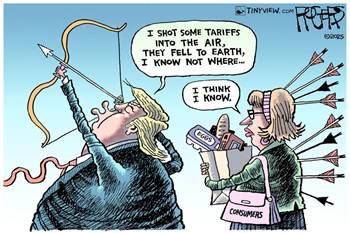
NOT EVEN A LITTLE BIT!

I DON’T THINK ABOUT AMERICANS’ FINANCIAL SITUATIONNOT EVEN A LITTLE BIT.

The most revealing moments in politics are often not the carefully written speeches or polished campaign ads. They are the unscripted comments that slip out when a politician answers quickly and speaks plainly. Oops! What did I just say? Not even a little bit?

That is why President Donald Trump’s recent statement hit so hard.

When asked whether Americans’ financial struggles were influencing his approach to negotiations with Iran, Trump answered: “Not even a little bit… I don’t think about Americans’ financial situation. I don’t think about anybody. I think about one thing: we cannot let Iran have a nuclear weapon.”

His defenders immediately argued that critics were taking the comment out of context. They say Trump was making a national security argument, not confessing indifference to ordinary Americans. Preventing Iran from obtaining a nuclear weapon, they argue, is more important than temporary economic discomfort.

That explanation may be fair. Context matters, but in this case I believe he is speaking his truth.

Words matter too.

Americans are exhausted. Grocery bills remain high. Rent and housing costs continue to climb. Credit card debt is growing. Families are working longer hours while feeling less secure. In that environment, hearing a president say he does not think about Americans’ financial situation lands badly no matter the intended meaning. As it should!

Leadership is not only about policy decisions. It is also about empathy. People want to believe their leaders understand what life feels like outside Washington. They want to hear that someone in power sees the pressure they are under.

This is not just about Trump. The reaction to his comment exposed something deeper: a growing belief that neither party truly understands ordinary people anymore.

Democrats seized on the statement immediately. Some mocked it online. Others argued Trump had “said the quiet part out loud.” Their criticism was politically predictable, but it also resonated because many Americans already feel disconnected from the political class.

Republicans mostly defended Trump’s intent while admitting the wording was rough. Some argued the media clipped the quote unfairly. Others said presidents sometimes must prioritize security over economics. That is true. National security decisions are rarely simple.

Still, the public frustration did not come from one sentence alone. It came from years of accumulated distrust.

Congress suffers from the same problem. Approval ratings remain consistently low because Americans increasingly see lawmakers as performers rather than problem-solvers. John Thune, Mike Johnson, Chuck Schummer, and Hakeem Jeffries are all actors in a play that has no role for ordinary Americans.

People watch endless partisan fights while basic concerns like affordability, healthcare, wages, and housing are unresolved. Many voters believe politicians spend more time protecting parties, donors, and media narratives than protecting citizens.

Whether that perception is entirely fair no longer matters. In politics, trust shapes reality. 

The danger for both parties is not simply anger. It is resignation. When citizens stop believing anyone in Washington genuinely cares about their daily lives, cynicism replaces participation. People disengage. Institutions weaken. Public trust erodes further. Citizens of America need to stay angry and demand their right to speak out, demand more from these actors, and vote for change even if it is just to change.

Ordinary citizens matter. Our congressman will not hold a town meeting because he does not want to hear points of view that differ from his own. So he ignores his constituents! Political disengagement thrives when people begin to believe their voices no longer matter, that government is too corrupt, too polarized, or to engaged in foreign policy matters to respond.

The most effective antidote is consistent civic participation at the local level, where ordinary citizens still have measurable influence. Voting in every election—not just presidential races—matters, but so does attending school board meetings, city council sessions, and town halls where decisions directly affect daily life. Citizens can organize around specific issues, support independent journalism, pressure elected officials through coordinated calls and public testimony, and build community groups that reconnect neighbors across political divides.

Democracy weakens when people retreat into cynicism and passive outrage online; it strengthens when citizens treat civic engagement as an ongoing responsibility rather than a once-every-four-years event. The reality is that disengagement benefits entrenched power, while participation—even imperfect participation—forces accountability.

Americans also need to hear something simple from their leaders: “We see what you are going through.”

T. Michael Smith

wwwtmichaelsmith.com

Unpacking Trump’s Corruption

This Massive Corruption Isn’t Subtle

In any functioning democracy, corruption is supposed to be the exception, a scandal that shocks the system and triggers accountability. But under Donald Trump, the concern is not about isolated misconduct. It’s about a pattern—one so consistent, so normalized, that it looks less like deviation and more like design.

Start with the most visible layer: the blending of public power and private profit. During his presidency, Trump has refused to fully divest from the Trump Organization, an unprecedented move in modern American politics. Foreign governments, lobbyists, and political allies frequently spend money at Trump-owned properties. These are not abstract ethics debates—they are questions about whether U.S. policy could be influenced by who booked a ballroom or a hotel suite. Several litigants alleged that President Trump’s retention of certain business and financial interests violates the Foreign and Domestic Emoluments Clauses. The Supreme Court ultimately found these cases moot without addressing their merits.

CRYPTO

The pattern has evolved with new financial tools as well. Trump and his allies have increasingly intersected with the world of cryptocurrency—including the promotion of NFT collections like the Trump Digital Trading Cards and fundraising efforts tied to crypto-friendly donors and platforms. While not illegal on its face, this raises fresh transparency concerns: crypto transactions can obscure donor identities, making it harder to trace influence. Critics argue that this creates a modern workaround to campaign finance norms. Money can flow with fewer disclosure requirements and less public scrutiny.

CONVICTION FOR FRAUD

Then there are the legal cases. The Trump Organization criminal trial resulted in convictions for tax fraud, exposing years of financial manipulation inside Trump’s business empire. In civil court, a New York judge found Trump liable for fraud in a sweeping case brought by Letitia James. The judge found that asset values were routinely inflated to secure loans and deflated to reduce taxes. These findings didn’t emerge from partisan talking points—they came from courts applying evidence and law. The New York Appellate Division overturned the $500 million penalty, ruling the disgorgement was an excessive fine that violates the Eighth Amendment. The five-member panel all upheld findings that Trump and his company were liable, affirming that James acted within her authority and that injunctive relief to curb Trump Organization practices was appropriate. Subsequently, Trump had his DOJ indict James for mortgage fraud. The case was dismissed.

LACK OF CONSEQUENCES

And yet, what makes this era distinct is not just the allegations or even the legal outcomes—it’s the erosion of consequences. Despite indictments, civil judgments, and ongoing investigations, Trump has maintained his political standing, although his poll numbers continue to decline. That reality raises a deeper concern: when accountability mechanisms fail to deter, what remains of the rule of law?

Supporters argue that Trump is the target of politically motivated prosecutions, a victim of what they see as a weaponized justice system. That claim resonates in a polarized country where trust in institutions has sharply declined. But the counterargument is just as stark: if overwhelming evidence, court rulings, and documented conduct cannot establish a shared baseline of reality, then corruption becomes not just tolerated, but partisan. Plus, Trump is using the judicial system to target his enemies.

This is the real danger. Corruption in the Trump era isn’t only about one man—it’s about whether democratic institutions can enforce ethical boundaries when those boundaries are systematically tested. If the answer is no, then the precedent extends far beyond Trump himself. Because once corruption is normalized, it doesn’t stay contained. It becomes the blueprint.

Conclusion: The System Under Strain

What makes this moment dangerous is not just the volume of allegations or even the seriousness of individual cases. It is the cumulative stress placed on democratic guardrails. Corruption, when repeated often enough without decisive consequence, stops looking like corruption at all. It becomes reframed as strategy, dismissed as politics, or absorbed into partisan identity.

Under Donald Trump, the traditional mechanisms of accountability—courts, elections, congressional oversight, and public opinion—have all been tested simultaneously. Courts have issued rulings, yet enforcement can be slow and politically fraught. Elections have served as a form of accountability, yet false narratives about their legitimacy have weakened their authority. Congressional oversight has often fractured along party lines, limiting its ability to function as a neutral check. And public opinion, once a stabilizing force, has hardened into camps that interpret the same facts in fundamentally different ways.

The deeper issue, then, is not whether any single act crosses a legal threshold. It’s whether the system can still produce a shared understanding of wrongdoing—and act on it. If one side views investigations as justice while the other sees persecution, accountability itself becomes unstable.

This is where newer mechanisms—like opaque financial channels in cryptocurrency or self-reinforcing media ecosystems—compound the problem. They don’t just enable potential misconduct; they make it harder to detect, prove, and build consensus around. Corruption thrives not only in secrecy, but in confusion.

History suggests that democratic erosion rarely happens in a single dramatic collapse. It happens gradually, as norms weaken, lines blur, and each new breach becomes easier to justify than the last. The risk is not simply that one leader tests the limits—it’s that those tests redraw the limits for everyone who follows.

If there is a path forward, it lies in reasserting that the rule of law is not situational, and that transparency is not optional. That requires more than legal outcomes—it requires institutional courage, political will, and a public unwilling to normalize what once would have been disqualifying.

Because once corruption is no longer disqualifying, democracy itself is no longer self-sustaining.

T. Michael Smith

wwwtmichaelsmith.com

The Normalization of White Nationalism

White Nationalism Walked Through the Front Door

White nationalism didn’t storm the gates of American democracy wearing hoods and waving torches. It walked in through the front door, badge clipped to a suit jacket, armed with talking points, legal memos, and a talent for laundering extremism into “policy.”

Its most effective practitioner is Stephen Miller.

For years, Washington treated Miller as merely a “hardliner,” a technocrat with strong views on immigration. That euphemism did the country enormous harm. Miller is not just tough on borders; he is the clearest example of how white nationalist ideology has been translated into federal governance—quietly, relentlessly, and with devastating human consequences.

This is not a matter of tone or style. It is about outcomes, intent, and ideology.

White nationalism, in its modern form, does not require explicit racial language. It advances the idea that the United States is fundamentally a white, European-descended nation whose survival depends on limiting the presence and power of people deemed “foreign,” especially those who are not white. Its core fear is demographic change. Its core strategy is exclusion.

Stephen Miller built policy around that fear.

From the first days of the Trump administration, Miller framed immigration not as a social or economic question, but as an existential threat—an “invasion,” a “flood,” a crisis engineered by outsiders to overwhelm the nation. This language was not incidental. It echoed the same rhetoric used in white nationalist propaganda for decades, recasting migrants as a hostile force rather than human beings.

Once you accept that framing, cruelty becomes policy.

Family separation was not an unfortunate byproduct of enforcement. It was the point. Miller himself pushed it as a deterrent, fully aware that it would traumatize children and parents alike. Refugee admissions were slashed to the lowest levels since the modern program began. Muslim-majority countries were singled out for bans under the pretense of “security.” Legal immigration pathways that disproportionately benefited non-European migrants were narrowed or dismantled.

Race was never mentioned. Racial hierarchy was enforced anyway.

Defenders still insist this was about “the law.” But the law has always allowed discretion—about whom to prioritize, whom to protect, whom to welcome. Miller’s discretion was consistently exercised in one direction: fewer Black and brown immigrants, fewer Muslims, fewer refugees, fewer poor people. More barriers. More suffering. More exclusion.

And then there is the paper trail.

Investigative reporting revealed Miller’s extensive private correspondence promoting white nationalist websites, extremist authors, and the infamous novel The Camp of the Saints—a book revered in neo-Nazi circles for its fantasy of violent resistance to nonwhite immigrants. These were not stray links or academic curiosities. They were ideological touchstones. Civil rights organizations did not mince words: this was the worldview of someone sympathetic to white nationalism, now shaping national policy.

What makes Miller uniquely dangerous is not just what he believed, but how competently he operated it.

This is the evolution of extremism in a mature democracy. It does not shout slurs. It drafts regulations. It does not riot. It litigates. It learns the language of courts, process, and precedent, using them as shields while advancing fundamentally anti-democratic goals.

The Trump administration provided the vehicle, but Miller provided the roadmap.

And here is the uncomfortable truth Democrats and the media must confront: much of this agenda survived because it was treated as a normal policy dispute rather than an ideological threat. “Border security” debates crowded out moral clarity. The press obsessed over Trump’s chaos while Miller quietly engineered durable damage inside the administrative state.

Courts blocked some of the worst abuses. They did not uproot the ideology. Nor did Congress meaningfully hold its architects accountable.

That failure matters now.

Because white nationalist politics does not disappear when an election ends. It waits. It refines. It looks forward to the next opening. The lesson of Stephen Miller is that democracy can be hollowed out not only by demagogues, but by bureaucrats who understand how to bend institutions toward exclusion without ever openly defying them.

This is not partisan excess. It is democratic self-defense.

If the United States is serious about being a multiracial democracy governed by the rule of law, then it must reject the lie at the heart of Miller’s project: that cruelty preserves the nation, that diversity is decay, that belonging must be rationed by race and origin.

Stephen Miller did not just influence immigration policy. He demonstrated how white nationalism can be made respectable—and how urgently it must be confronted, named, and defeated.

Call to Action

The lesson of Stephen Miller is not simply that one extremist gained power. It is that American institutions were willing to normalize white nationalist governance as a legitimate policy position so long as it was expressed politely and wrapped in legal language.

That cannot continue.

Democrats must stop treating immigration cruelty as a matter of “messaging” and start naming it for what it is: an assault on multiracial democracy. Congressional oversight should not be symbolic. It should be aggressive, sustained, and aimed squarely at the architects of these policies, not just their most visible mouthpieces. The administrative state must be rebuilt with safeguards that prevent ideological extremism from being laundered into regulation.

The media, too, must abandon its addiction to euphemism. There is a moral difference between policy disagreement and racial exclusion. When journalists describe white nationalist outcomes as “hardline” or “controversial,” they obscure the truth and protect the powerful from accountability.

And the public cannot look away. White nationalism does not announce itself with banners. It advances through apathy, exhaustion, and the false belief that “it can’t happen here.” It already has.

Stephen Miller’s legacy is a warning. If his ideas remain viable inside mainstream politics, then the problem is larger than one man. It is a test of whether American democracy is willing to defend itself—not just from overt authoritarians, but from the quieter, more disciplined extremists who know how to work the system from within.

Democracy survives only when it draws lines—and enforces them. Now is the time to do both.

T. Michael Smith

wwwtmichaelsmith.com

A DIVERSIONARY WAR

You Can’t Bomb Your Way Out of Rent: What Really Forces Leaders Back to Domestic Reform

When domestic problems pile up—rising costs, broken institutions, political paralysis—leaders have a familiar escape hatch: look outward. Foreign crises, military posturing, and talk of national security can temporarily drown out questions about wages, housing, healthcare, and democratic accountability. History shows this tactic works just long enough to be tempting—and just long enough to do real damage.

The harder question isn’t why leaders distract. It’s what actually forces them back to governing at home. The answer is uncomfortable for those in power and clarifying for everyone else: leaders return to domestic reform only when avoidance becomes more costly than change.

That pressure does not come from speeches or slogans. It comes from forces that, when activated together, are impossible to ignore—starting with economic reality and electoral accountability.

Domestic economic pain—higher rents, stagnant wages, debt burdens—cannot be spun away. Foreign policy adventures are expensive, and even when wrapped in patriotic language, they rarely deliver quick relief for ordinary people. Eventually, budgets strain, infrastructure decays, and voters notice that the money spent abroad could have fixed things at home.

Elections also matter when they genuinely determine political fate. Voters may rally around flags and crises for a short time, but they care more about grocery bills and job stability. When people believe leadership can change and that their vote counts, domestic issues reassert themselves.

Nowhere is this dynamic clearer than in the Trump administration’s recent actions in Venezuela. The U.S. military operation that captured President Nicolás Maduro in early January, framed as a strike against narco-terrorism, seized global attention and deeply divided Americans along partisan lines. Many Republicans cheered the move as a bold assertion of U.S. strength; many Democrats and independents condemned it as an illegal intervention that bypassed Congress and violated international norms. Early polling shows a stark split: roughly two-thirds of Republicans support the action, while only about one in seven Democrats do—and most Americans believe Congress should have been consulted first.

Critics on both the left and right have accused the White House of using Venezuela as a diversionary tactic—a way to shift public attention away from deep economic anxieties, congressional dysfunction, corruption scandals, and domestic policy failures. Comparisons have been made to historic cases where foreign policy was used to try to deflect from internal problems, with strategists explicitly suggesting that dramatic military moves can serve as a political smoke screen.

Oil makes diversion more effective because it affects everyone’s life. Oil is uniquely useful in this context. Gas prices, heating costs, and inflation are immediately felt by voters. Linking a foreign action to the diversion gives leaders a concrete justification that resonates more than abstract ideology.

The timing and presentation of the Venezuela operation fit a pattern seen in U.S. politics before: rally support with talk of national security, justify extraordinary action with moral language, and hope that media cycles focus on external enemies more than internal failures. When oil reserves—like Venezuela’s vast fields, which are now at the center of strategy and controversy—enter the mix, foreign policy gains an economic gloss that resonates with some voters even as it distracts from domestic debates about inflation and labor conditions.

 The diversion never lasts. What forces leaders back to domestic reform—economic pain that cannot be ignored, elections that matter, elite repudiation, institutional resistance, and public exhaustion—cannot be sidestepped by spectacle alone. People don’t want permanent resistance; they want competence and stability. Housing, healthcare, and wages become paramount. When voters connect foreign spending to domestic neglect, reform becomes unavoidable—or leadership changes.

Elite defection is decisive when it happens: when business leaders, military professionals, and bureaucratic insiders quietly conclude that diversion costs more than accountability. Institutions like courts and legislatures don’t need to “win”—they only need to slow, expose, and delay. Public exhaustion matters too; permanent crisis politics collapses once citizens demand competence over chaos. Oil companies recognize the distractive nature of this action and are not willing to participate at this point.

What doesn’t work alone are moral outrage, hashtags on X, or viral moments. These fade unless they are connected to material consequences and institutional leverage. But the murder of an American citizen by an ICE agent could be that material consequence. Renee Nicole Good, a 37-year-old U.S. citizen and mother of three, was fatally shot by a U.S. Immigration and Customs Enforcement (ICE) agent Jonathan Ross during a federal immigration enforcement operation in south Minneapolis.  The incident has sparked widespread protests and political debate across the U.S., with thousands demonstrating against ICE’s presence and tactics, and lawmakers calling for independent investigations and greater accountability.

The uncomfortable truth is that domestic reform happens not because leaders “see the light,” but because: the cost of not reforming becomes higher than the cost of trying another diversion. Democracy survives when citizens, institutions, and economic realities make avoidance a non-starter. Change arrives because the country insists on it—and makes every other option impossible.

You can’t bomb your way out of rent or partisan dysfunction. You can’t sanction your way to affordable healthcare. And you can’t distract forever from a system that no longer delivers for working families.

Domestic reform comes when citizens make avoidance more costly than accountability. That’s when leaders are forced back to work on the problems that matter most.

T. Michael Smith

wwwtmichaelsmith.com

Chief Justice John Roberts

OLD and QUIRKY

From Conservative Strategist to Chief Justice of a Court He Can No Longer Control

For years, Chief Justice John Roberts was hailed—mostly by Beltway moderates desperate to find a “reasonable” conservative—as the last adult in the room. The sober institutionalist. The guardian of the Court’s legitimacy. The conservative who understood that you don’t burn the house down just because you finally got the matches.

But the truth is far less flattering: John Roberts didn’t save the Court from extremism. He midwifed it. He curated it. And now, like Dr. Frankenstein watching his monster rampage through the village, he’s horrified that he’s no longer the one in charge.

Roberts’ evolution isn’t a story of a principled jurist tempering his ideology. It’s the story of a Republican operative who spent decades dismantling democratic safeguards—voting rights, campaign finance limits, corporate accountability—only to recoil when a more radical generation of conservatives used those very tools to push the country off a cliff.

The Strategist Who Mistook Himself for a Statesman

Roberts rose through the conservative legal movement carefully, methodically, strategically. He wasn’t the bomb-thrower; he was the man smoothing the shrapnel, packaging hard-right outcomes in pretty, technocratic prose. His entire judicial philosophy was camouflage: causing massive ideological shifts, but made them look modest.

His decision in Shelby County v. Holder—gutting the Voting Rights Act—was a masterpiece of this dreary craft. He pretended that racial discrimination in voting had magically evaporated, then acted shocked when states sprinted to reinstate voter suppression laws.

This was Roberts’ signature: deregulate the powerful, weaken protections for vulnerable communities, and then express mild surprise when the powerful seize even more power.

Then Came the Monster He Helped Build

For a decade, Roberts controlled the Court by managing Justice Kennedy’s ego and projecting a veneer of institutional neutrality. But once the far-right legal movement captured the Court outright—with Gorsuch, Kavanaugh, and Barrett—Roberts became irrelevant.

And nothing infuriates a man like Roberts more than being irrelevant.

Suddenly he was the “moderate,” not because he changed, but because the rest of the conservative bloc stopped pretending. They didn’t care about incrementalism. They didn’t care about public trust. They didn’t care about Roberts’ obsession with legitimacy. They wanted maximalist rulings, and they wanted them now.

Dobbs was the humiliation heard round the world. Roberts begged for a “compromise,” a middle-ground fantasy where abortion rights could be gutted but not eradicated. The new majority waved him off like an annoyed parent. They had the votes, and they were done with Roberts’ slow-drip revolution.

Roberts Wants to Save the Court From a Crisis He Caused

Roberts keeps warning that the Court risks losing the public’s trust—as if he had no role in setting the stage for its collapse. It was Roberts who weakened the Voting Rights Act. Roberts who empowered billionaire donors in Citizens United. Roberts who shielded corporate interests repeatedly. Roberts who insisted, with a straight face, that the Court is not political even as he stacked the deck for conservative victories.

And now he wants to play umpire while the game burns down.

Roberts didn’t lose control of the Court because he’s a moderate; he lost control because the right-wing legal movement he nurtured no longer needs his caution or his respectability. They have the majority. They have power. And the mask—his mask—is off.

Roberts’ Legacy Is the Court’s Crisis

History won’t remember Roberts as the savior of judicial legitimacy. It will remember him as the architect of the Court’s collapse into partisanship—a man who spent years quietly eroding the foundation of democracy only to be shocked when the roof finally caved in.

He wanted to steer a conservative revolution from the comfort of technocratic respectability. Instead, he built a machine that outran him. He fed the beast, and now it answers to someone else.

John Roberts evolved, all right—not into a moderate, but into a cautionary tale: a conservative who played with fire, insisted it was safe, and now stands in the ashes pretending not to smell the smoke.

T. Michael Smith

wwwtmichaelsmith.com

How Citizens United Broke America’s Democracy

OLD and QUIRKY

Why the Billionaires Want You to Forget It

There are a lot of villains in the slow-motion sabotage of American democracy, but few have done more damage—with such smug self-righteousness—than the Supreme Court’s conservative majority in Citizens United v. FEC. With a single ruling, they didn’t just unleash corporate money into politics. They handed the keys of American democracy to the ultra-wealthy and told the rest of us to enjoy the ride.

The right loves to blame polarization, misinformation, even “wokeness” for the chaos in politics. But let’s be honest: the rot set in when the Court declared that corporations are political actors with constitutional rights and billionaires can drown the public square in money if they call it “independent spending.”

It was the judicial equivalent of opening all the vaults on Wall Street and telling the bankers, “Go wild.” And they did.

A Democracy of Donors, Not Voters

Since the ruling, politics has become a playground for the richest Americans—a system where a handful of billionaires can bankroll entire elections, sculpt policy, and effectively decide who even gets a shot at running for office. Working people donate in $20 increments: Sheldon Adelson and Michael Bloomberg toss in $100 million like they’re tipping a bartender.

This isn’t free speech. It’s financial dominance.

The conservative justices insisted that unlimited spending would not corrupt politics because it was technically “independent.” That’s like claiming a hurricane isn’t dangerous because the wind and water don’t officially coordinate. The reality is obvious: when politicians know a super PAC can vaporize their career with a tsunami of attack ads, they behave accordingly. It’s silent extortion, baked into the system.

Dark Money: The Shadow Government

Worse still, Citizens United opened the floodgates for dark money—funds from anonymous donors funneled through nonprofits that exist solely to hide who’s really pulling the levers.

These groups bankroll everything:

  • judicial confirmation blitzes
  • anti-union campaigns
  • disinformation networks
  • climate denial operations
  • statewide ballot fights
  • and candidate-centered propaganda masquerading as “issue ads”

It’s a shadow government with no accountability and no transparency, operating because five justices thought disclosure requirements might “chill speech.” What it chills is democracy.

Policy Written for the Few, Paid for by the Few

There’s a reason Congress can’t pass wildly popular policies like taxing billionaires, raising wages, strengthening unions, or protecting abortion rights. Donors don’t want them.

There’s a reason fossil fuel companies keep winning legislative battles even as the planet burns. Donors pay handsomely for political insulation.

There’s a reason health care remains a corporate profit engine instead of a public good. Dark money groups fueled by insurance executives spend tens of millions to ensure nothing changes.

This is not dysfunction. It’s design.

Public Trust Has Collapsed—and That Was the Point

Americans know the system is rigged. They feel it every time a policy with 70–80% support dies in committee while billionaires get another round of tax cuts. They see it when candidates who appeal to grassroots voters get buried under a flood of super PAC money.

The right often accuses the left of being cynical about institutions. But cynicism didn’t break our faith in democracy. Citizens United did.

The Billionaires Don’t Want Reform—They Want Silence

Every time someone proposes overturning Citizens United, strengthening disclosure laws, or implementing public financing, the same chorus emerges: “You’re trying to limit speech.”

No. We’re trying to resurrect democracy from the ruins your “speech” left behind.

The truth is simple: the only people who benefit from Citizens United are the people with enough money to buy political power. Everyone else pays the price—in weaker protections, broken institutions, and a political system that treats citizens like spectators instead of participants.

It Has to End

A democracy cannot survive when the wealthiest Americans have more political influence than millions of voters combined. The idea that corporations are people with constitutional rights is a lie. The idea that billionaires’ spending is harmless is a fantasy. And the idea that this system is sustainable is delusional.

Citizens United must be overturned—by constitutional amendment, by new disclosure laws, or by a Court that finally remembers democracy matters more than donor privileges.

Until then, the United States will remain a country where elections are technically free, but political power is anything but.

T. Michael Smith

wwwtmichaelsmith.com

MAGA IS NOT A MOVEMENT

It’s a Warning Label for American Democracy

For years, pundits have treated “MAGA” like a marketing slogan with an attitude problem. But at this stage in American politics, it’s clear that MAGA isn’t just a hat or a rally chant. It has become a full-blown ideology built on resentment, mythmaking, and the insistence that democracy should bend to the will of one man. To pretend otherwise is to miss the central political story of our time—and the central threat facing the country.

MAGA presents itself as a grassroots uprising of “real Americans” against a corrupt elite. But scratch the surface and something very different appears: a movement convinced that the pluralistic, multiracial democracy we live in is inherently illegitimate. Its core message is unmistakable: the only valid votes are the ones cast for its own side; power lost is power stolen; institutions—from the courts to the press to elections themselves—are presumptively fraudulent unless they deliver the “correct” outcome.

This is not traditional conservatism. It is not small government or fiscal restraint. MAGA’s ideology begins and ends with a single premise: Trump is the state, and the state must serve Trump. Everything else—immigration panic, culture-war theatrics, attacks on public servants, threats of retribution—flows from that central impulse.

The cruelty isn’t incidental. It’s the brand. MAGA needs enemies because fear is the fuel that keeps the machine running. Immigrants, LGBTQ Americans, civil servants, teachers, journalists—anyone who refuses to conform to the MAGA myth of a homogenous, obedient America becomes a target. When you hear the chants about “taking our country back,” it’s worth asking from whom? The answer, often, is from fellow Americans who simply don’t look, vote, pray, or think like them.

Where Christian Nationalism Supercharges the Project

If MAGA were merely a political movement, it would be dangerous enough. But its power is magnified by the rise of Christian nationalism, which wraps authoritarian politics in religious language and moral entitlement. Christian nationalism insists that America was founded for Christians, by Christians, and must be governed through their preferred hierarchy of values. It casts secular government, pluralistic democracy, and church–state separation as threats rather than founding principles.

By fusing MAGA identity with religious destiny, the movement transforms political loyalty into a form of theological certainty. Opponents are not just wrong; they are ungodly. Democratic limits are not just inconvenient; they are immoral. This is why MAGA rhetoric so often veers into apocalyptic storytelling—claims that America faces spiritual warfare, that Trump is a chosen vessel, that compromise is betrayal of a divine plan.

When politics is reframed as holy conflict, the possibility of democratic coexistence collapses. Compromise becomes heresy; pluralism becomes an existential threat. Christian nationalism gives MAGA something every authoritarian movement seeks: a sacred justification for minority rule.

The Appeal—and the Manipulation

The tragedy is that MAGA harnesses real grievances. Millions of Americans do feel abandoned—by globalization, automation, stagnant wages, and political leaders more attuned to donors than to working families. Institutional failures are real. Economic inequality is real. Public distrust is real.

But instead of offering solutions, MAGA offers scapegoats. Instead of solidarity, it builds walls—literal and metaphorical. Instead of expanding opportunity, it narrows the definition of who belongs. It exploits pain without alleviating it, turning legitimate frustrations into fuel for a political project that leaves everyday people even more vulnerable.

For a movement that claims to fight elite power, MAGA has delivered almost nothing that helps ordinary Americans: tax cuts skewed to the wealthy, deregulation that favors corporations, culture-war diversions that do nothing to improve wages, safety, health care, or education. What it reliably delivers is spectacle—outrage cycles that keep supporters angry and the rest of the country exhausted.

Democracy as an Obstacle, Not a Value

The deeper danger is that MAGA has normalized the idea that democracy itself is optional. A functioning democracy requires more than elections; it requires shared rules of the game and a shared commitment to honoring them. MAGA rejects both. It demands loyalty not to the Constitution, but to personality. It treats the peaceful transfer of power as negotiable. It elevates conspiracy theories to the level of civic doctrine. And it conditions millions of Americans to see defeat as proof of fraud rather than a routine feature of democratic life.

The movement’s enthusiasm for purges, show trials, and loyalty tests is no accident. It is the natural outcome of a worldview that sees pluralism as weakness and dissent as treason. MAGA is trying to make authoritarianism feel familiar—almost patriotic.

A Radical Minority Movement, Not an Unstoppable Majority

One of the greatest myths surrounding MAGA is its supposed inevitability. In reality, it represents a radical minority with outsized influence because the majority often remains silent, fatigued, or intimidated. MAGA’s power grows not from broad public support but from intensity—the willingness of its followers to treat politics as a battlefield while everyone else tries to get on with their lives.

But democracies don’t survive on autopilot. They survive because enough people decide they’re worth defending.

The Choice Ahead

America has many political traditions worth celebrating. MAGA is not one of them. It is a warning label: a reminder that democracies don’t collapse only in distant countries or dusty history books. They can be hollowed out from within, one purge list at a time, one conspiracy theory at a time, one “stop the steal” at a time.

The real question now is whether the rest of us treat MAGA as an unstoppable force or what it truly is—a dangerous but minority movement that only thrives when the majority refuses to confront it.

Silence is how democracies unravel. A clear-eyed refusal to bow to fear is how they endure.

T. Michael Smith

wwwtmichaelsmith.com

Who Won the Shutdown?

OLD and Quirky                                 

Republicans claimed victory. Democrats claimed pragmatism. But the real loser is democracy itself.

After 41 days of paralysis, furloughs, and fury, the federal government is finally lurching back to life. But while Washington congratulates itself for reopening the doors, Americans deserve to ask the real question: Who actually won the shutdown? The short answer is the same as it’s been for years—Republicans played hardball and Democrats blinked. The longer answer is more troubling: democracy itself lost ground.

The shutdown began as a standoff over something as basic as keeping the government funded and health care affordable. Republicans, emboldened by Trump’s renewed grip on Congress, refused to pass a budget that continued the Affordable Care Act subsidies millions rely on. Democrats, for once, stood their ground—at least at first—insisting that health care wasn’t a bargaining chip. For a moment, it seemed like they might hold together. But that moment passed.

As the weeks dragged on, pressure mounted: federal workers without paychecks, veterans missing benefits, food aid paused, airports in disarray. The human cost became unbearable. And when the breaking point came, it wasn’t the Republican leadership that cracked—it was the Democrats. Seven of them, along with an Independent, crossed the aisle to vote for a temporary deal that funded most agencies but postponed the health-care fight until December. The right called it pragmatism. The left called it surrender. Both were right.

Republicans walked away with the win they wanted. They reopened the government on their terms, without restoring the ACA subsidies that had triggered the crisis in the first place. They also sent a message: when Democrats talk about “no negotiation with hostage-takers,” they don’t really mean it. The GOP knows this game, and they play it well, manufacture a crisis, hold the economy hostage, and wait until moderates fold. It’s governing by brinkmanship, and it works because Democrats keep rewarding it.

But the political scoreboard isn’t the only thing that matters here. This shutdown exposed something deeper about the state of our democracy: we’ve normalized dysfunction. Americans barely flinched as the government shut its doors for over a month—the longest in U.S. history. The headlines were predictable, the outrage short-lived. Shutdowns are supposed to be unthinkable; now they’re routine. That’s not just bad politics; it’s a failure of civic imagination. We’ve come to expect chaos, and in that expectation, we’re losing the will to demand better.

Democrats will say they ended the shutdown to protect working families—and to a degree, that’s true. The public needed relief. But a deal that buys peace at the price of principle isn’t a victory; it’s a truce before the next defeat. By agreeing to revisit the ACA subsidies in December, they’ve simply postponed another crisis. Republicans, meanwhile, have every incentive to repeat the tactic. Why negotiate in good faith when obstruction pays dividends?

Still, this isn’t a story without hope. The divide within the Democratic Party—the progressives furious about capitulation and the moderates who claim to be realists—may yet lead to a reckoning. If Democrats want to stop losing these hostage situations, they need to stop accepting the terms. That means learning how to frame these fights not as “Washington dysfunction,” but as deliberate Republican sabotage of government itself. It means talking less about bipartisanship and more about accountability. The party that believes in government must finally learn to defend it with the same zeal that the other side shows in tearing it down.

Who won the shutdown? In the short term, Republicans. In the long term, no one—unless Democrats start treating governance not as a concession, but as a cause worth fighting for. The shutdown wasn’t just a budget dispute; it was a test of conviction. And once again, Democrats settled for survival instead of victory.

If there’s any lesson to draw, it’s this: the GOP is united by grievance, but Democrats can still be united by purpose. Ending this cycle requires courage—not just to reopen the government, but to rebuild faith that government matters. Until then, every shutdown will end the same way: with Republicans celebrating, Democrats rationalizing, and Americans paying the price.

T. Michael Smith

wwwtmichaelsmith.com

INSIDERS RULE

Behind the public drama of politics, three powerful insiders—Russell Vought, Stephen Miller, and Pete Hegseth—are quietly reshaping how America is governed. Through budgetary control, ideological messaging, and military command, they are centralizing executive power and transforming democratic institutions from within.

The Impact of Russell Vought, Stephen Miller, and Pete Hegseth

In American politics, power often hides behind the curtain. The figure at the podium is rarely the only force directing the show. Today, three men—Russell Vought, Stephen Miller, and Pete Hegseth—are shaping the contours of government in ways more consequential than any press briefing or campaign rally could convey. They are the insiders of a movement that seeks to refashion not just policies but the very machinery of governance. Together, they represent a new breed of political operator: ideological, disciplined, and determined to subordinate the federal bureaucracy, the military, and the rule of law to a single, commanding vision of executive supremacy.

Russell Vought: The Bureaucratic Revolutionary

Russell Vought, Office of Management and Budget (OMB) director and current architect of the administration’s institutional redesign, operates with a precision born of bureaucratic mastery. His influence extends beyond spreadsheets and budget charts; he is the administrative mind behind what might be called the “restorationist” project—an effort to reclaim the executive branch from what he calls the “deep state.”

Vought has made no secret of his disdain for the permanent civil service. He once said that career bureaucrats should “wake up demoralized,” viewing them as obstacles to the will of the people rather than instruments of democratic governance. His Center for Renewing America, a policy hub that grew out of the Project 2025 blueprint, preaches a mission of cultural and bureaucratic purification—firing, defunding, or dismantling agencies that resist ideological alignment.

Through OMB’s power of the purse, Vought wields quiet but devastating influence. By redirecting grants, freezing disfavored programs, and using impoundment tactics that test the boundaries of congressional authority, he can starve the government’s watchdogs while feeding politically compliant agencies. His budgetary maneuvers operate in the shadows, invisible to the public but transformative in effect. It is governance by attrition—a war on the bureaucracy fought with spreadsheets and rulebooks.

The danger in Vought’s project is not just its ideological bent but its structural audacity. If the executive branch can starve parts of itself without oversight, Congress becomes ornamental. The balance of powers begins to tip, not through coup or crisis, but through the slow erosion of institutional muscle.

Stephen Miller: The Ideologue as Architect

If Vought is the tactician, Stephen Miller is the ideologue. For nearly a decade, Miller has supplied the movement with its defining rhetoric—its story of siege, crisis, and moral war. His fingerprints are on nearly every hardline immigration and security policy of recent years, but his influence runs deeper than policy. He is the voice that tells a particular faction of America that they are losing their country, and that only strongmen and exceptional measures can save it.

Miller’s genius lies in framing every policy dispute as a battle for civilization itself. Court rulings, media criticism, or congressional oversight are not seen as democratic processes but as existential assaults. In this narrative, compromise becomes betrayal, and resistance is treason.

This rhetoric has policy consequences. When officials are described as “enemies within,” it justifies purges. When judicial constraints are recast as “insurrection,” it legitimizes executive defiance. Miller’s language—once dismissed as campaign bluster—now shapes the tone and tenor of actual governance. His worldview defines who belongs and who doesn’t, who deserves protection and who must be punished.

Even within Republican ranks, Miller’s absolutism has provoked anxiety. Some strategists warn that his style of politics—driven by confrontation rather than persuasion—risks alienating allies and moderates. Yet Miller’s influence persists because he has mastered the emotional grammar of populism. He gives moral urgency to the machinery Vought is re-engineering.

Pete Hegseth: The Soldier-Politician

Where Vought manipulates budgets and Miller molds narratives, Defense Secretary Pete Hegseth embodies the movement’s muscle. A former Army officer and Fox News commentator, Hegseth has redefined the Pentagon’s mission to align with culture-war politics. His rhetoric is steeped in calls for a return to “warrior ethos” and a purge of what he derides as “woke” ideology.

Under Hegseth’s leadership, the military’s focus has shifted from global alliances toward internal purification. He has removed diversity, equity, and inclusion offices, disciplined officers deemed politically disloyal, and re-centered defense discourse around patriotism, masculinity, and obedience. In public speeches, Hegseth often warns that the “real threats” to America are not foreign adversaries but internal decay—an argument that edges dangerously close to politicizing the military itself.

Recent controversies surrounding leaked internal communications—revealing the sharing of sensitive operational details on private channels—highlight the erosion of professional norms within the defense establishment. The line between civilian control of the military and partisan mobilization is thinning. When the Pentagon becomes a stage for ideological cleansing, the apolitical character of the armed forces—the bedrock of American stability—comes under strain.

Hegseth’s impact is not only operational but symbolic. He represents the militarization of political identity—the idea that loyalty and strength outweigh process and pluralism. That ethos, once confined to cable talk shows, is now shaping command decisions and promotions.

The Triad of Power

Individually, Vought, Miller, and Hegseth wield immense influence within their domains. Collectively, they represent a coherent strategy: to consolidate executive authority, neutralize bureaucratic resistance, and reframe democracy as a struggle between patriots and traitors.

Their methods intersect. Miller provides the moral justification; Vought designs the bureaucratic architecture; Hegseth enforces the cultural and military discipline. The result is a kind of ideological fusion—one that sees government not as a pluralistic arena of negotiation, but as a unified instrument of will.

In this configuration, checks and balances are not safeguards but obstacles. Independent agencies, congressional oversight, and judicial review are recast as forms of sabotage. The traditional American notion of governance—built on deliberation and dispersed power—gives way to a more centralized, combative model: rule by command rather than consent.

The Risks Ahead

The genius of this insider movement lies in its subtlety. There is no overt coup, no tanks in the streets. Instead, there is administrative attrition, rhetorical escalation, and institutional corrosion. It is power exercised through procedures, not proclamations.

The immediate consequence is polarization, but the long-term danger is institutional fatigue. A government demoralized and distrusted cannot sustain itself indefinitely. Bureaucrats stripped of independence become servants of the moment. Generals politicized by ideology lose credibility with the public. And when every opponent is treated as an enemy, democracy becomes indistinguishable from permanent war.

There are, of course, countervailing forces—career officials who resist unlawful orders, courts that push back, and citizens who still believe in pluralism. But the burden of resistance has shifted from institutions to individuals. The system that once protected itself now depends on the courage of those within it.

Conclusion: The Architecture of Control

Russell Vought, Stephen Miller, and Pete Hegseth are not fringe figures; they are the governing class of a movement intent on remaking the American state in its own image. They wield ideology as strategy and bureaucracy as weapon. Their goal is not just to win elections but to rewire government itself—to replace institutional balance with ideological purity.

The story of these insiders is a reminder that democracies rarely fall in dramatic fashion. More often, they are remodeled from within—one regulation, one firing, one speech at a time. The question now is not whether their influence will endure, but how much of the old constitutional order will remain when they are done.

Trump’s Takeover Attempt

The Constitution Is The LAST Line of Defense

OLD and QUIRKY Michael Smith

When the framers wrote the U.S. Constitution in 1787, they weren’t designing a government for angels. They built a system for ambitious, flawed, and power-seeking human beings — precisely to prevent the rise of a single man who might try to rule like a king. Today, as Donald Trump openly vows to use a second term to exact “retribution” on his enemies and weaken constraints on presidential power, that 18th-century framework has become our last line of defense. The Constitution — if we have the courage to uphold it — remains America’s strongest bulwark against an authoritarian takeover.

A Government of Divided Power

The Founders’ most brilliant invention was the separation of powers. No single person, not even a president, was meant to dominate. Congress makes the laws, the president enforces them, and the courts interpret them — a system built to force compromise and prevent tyranny. That design ensures a president cannot simply rule by decree or loyalty.

During Trump’s first term, this balance was tested — and in some cases, it held. Courts struck down the most sweeping version of his “Muslim ban,” blocked his attempts to redirect funds for a border wall, and resisted executive overreach. State officials, under tremendous pressure, refused to falsify election results. These acts of defiance were not partisan gestures; they were affirmations of the Constitution’s core principle that power must remain divided and accountable.

The Rule of Law, Tested but Alive

The Constitution promises that no person is above the law — a principle now facing its hardest test. Trump, indicted in multiple jurisdictions, has built his campaign around the claim that accountability itself is illegitimate. If judges and juries uphold their constitutional duty despite political pressure, they will reaffirm that the rule of law is more than a slogan. If they falter, the entire foundation of our democracy will crack.

But the rule of law doesn’t live only in the courts. It lives in the character of those who swear an oath to uphold it — from soldiers to civil servants. Every official in this country pledges allegiance not to a leader, but to the Constitution. That distinction is what separates a republic from a regime. When senior military officers reminded Trump in 2020 that their loyalty was to the Constitution, not to him, they were echoing that sacred promise.

The People’s Power

Ultimately, the Constitution’s greatest safeguard is us — the people. It entrusts power not to kings or generals but to citizens who speak, vote, and act. Free elections, free speech, and a free press are not ornaments of democracy; they are its beating heart. The First Amendment guarantees the right to challenge authority, expose corruption, and protest injustice.

Trump and his allies have tried to convince Americans that elections can’t be trusted and that truth itself is negotiable. That cynicism is corrosive — and deliberate. If citizens lose faith in their own institutions, the paper protections of the Constitution will mean little. The antidote is civic participation: voting in every election, defending factual journalism, volunteering in communities, and refusing to surrender truth to conspiracy.

Federalism and the Limits of Power

Another constitutional strength lies in federalism — the division of power between the national government and the states. This structure makes it extraordinarily difficult for one person to control every lever of authority. When Trump pressured state officials in 2020 to “find votes,” they refused. When he mused about deploying the military to silence protests, generals and governors resisted. That was federalism at work: a reminder that sovereignty is shared, not seized.

A Fragile Line Between Republic and Rule

Still, the Constitution is not self-enforcing. It is a set of promises that rely on human courage to survive. If Congress abdicates oversight, if courts bow to political intimidation, or if citizens stop paying attention, the republic can be hollowed out from within. History teaches that democracies rarely die in a single moment — they erode through exhaustion, cynicism, and fear.

Trump’s public vows to use the presidency as an instrument of vengeance should alarm anyone who still believes in limited government. But outrage alone won’t save the republic. What will save it is constitutional courage — lawmakers willing to say no, judges willing to rule on principle, citizens willing to act when democracy is under threat.

The Oath We All Share

Every public servant swears to “preserve, protect, and defend the Constitution of the United States.” In times like these, that oath belongs to all of us. The Constitution is not just a relic of parchment; it is a living agreement between the governed and those who govern. It gives us tools — elections, courts, and checks on power — but it also gives us responsibilities.

If Americans choose apathy, the Constitution cannot save us. But if we choose engagement, courage, and truth, it will. The Founders never promised that freedom would be easy — only that it would be possible. The question now is whether we will use the system they built to defend it.

Because in the end, constitutional patriotism means loyalty not to a man, but to the rule of law itself — and to the idea that no one, not even Donald Trump, is above it.

T. Michael Smith

wwwtmichaelsmith.com