Understanding the MAGA Platform

THE ECONOMIC IMPACT OF AMERICA FIRST POLICIES

“MAGA” — shorthand for Make America Great Again — isn’t a single policy platform so much as a cluster of political goals and instincts that coalesced around Donald Trump. If you strip away the slogans, a few core aims show up consistently.

1. Economic nationalism
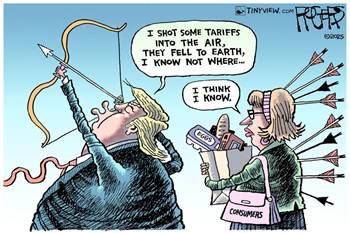
A central goal is to prioritize domestic industry over global integration. That means tariffs, skepticism of free trade agreements, and efforts to bring manufacturing back to the U.S. The theory is simple: protect American jobs even if it disrupts global supply chains. This disruption often leads to higher prices.

2. Restrictionist immigration policy
MAGA emphasizes tighter border control, reduced legal immigration in some cases, and aggressive enforcement (ICE enforcement policies). The underlying argument is that sovereignty and labor market stability depend on controlling who enters the country.

3. Strong executive power
There’s a clear preference for a more assertive presidency.  Using executive authority to push policy when Congress stalls is the strategy. Supporters see this as necessary to overcome gridlock. Critics see it as a threat to institutional checks and balances. The ultimate goal is authoritarian rule.

4. Cultural conservatism
MAGA places heavy emphasis on traditional national identity, patriotism, and resistance to social change. This often includes opposition to what supporters’ call “elite” or “woke” cultural norms in media, education, and government.  

5. Skepticism of institutions
A defining feature is distrust of established institutions. This includes federal agencies to mainstream media to international alliances. Organizations like NATO are sometimes framed as burdens unless they clearly serve U.S. interests.

6. “America First” foreign policy
Less focus on multiple country deals, more emphasis on bilateral deals and reducing long-term foreign entanglements. Although in practice this has been uneven, especially when strategic or economic interests are at stake.

7.  White Male Hierarchy

As policy evolves, people of color and women occupy a contested place within the worldview associated with Make America Great Again. Supporters argue the movement is fundamentally race- and gender-neutral. It simply emphasizes nationalism, economic opportunity, and traditional values over identity-based politics.  They point to growing (though still very limited) support among some Latino and Black voters and strong backing from many conservative women. But  its policy priorities and cultural framing—on immigration, voting access, reproductive rights, and opposition to diversity initiatives—tend to disproportionately affect people of color and constrain women’s autonomy.  This view elevates a narrower vision of national identity that aligns more closely with traditional white male hierarchies. The result is a tension at the core of the movement: it seeks broad-based populist appeal yet often advances policies and narratives that many women and minority communities experience as exclusionary and discriminatory.

The Reality Check
These goals don’t always fit neatly together. For example, economic nationalism can raise prices for consumers, and limiting immigration can strain industries that rely on labor. Likewise, skepticism of institutions can energize supporters but also weaken the very systems that keep government accountable.  Exclusion of women and people of color will often be the norm particularly in voting.

So MAGA isn’t just a policy agenda. It’s a worldview: one that prioritizes national sovereignty, cultural cohesion, and centralized political will. This view diminishes or eliminates our long-standing democratic norms and global systems.

The Real Cost of “America First”

“America First” sounds simple, even intuitive. But as Make America Great Again becomes policy, its effects are anything but simple. They show up not in speeches, but in grocery aisles, rent payments, hospital bills, and classrooms across places like Virginia.

Start with the basics: food and housing. Restricting immigration and imposing tariffs—policies central to the MAGA agenda—are meant to protect American workers. But they also reduce the labor supply in agriculture and construction while raising the cost of materials. The result is predictable: groceries inch upward, housing becomes more expensive to build, and rents follow. These aren’t abstract tradeoffs; they are weekly hits to household budgets.

Wages tell a more complicated story. Some workers, particularly in manufacturing or sectors facing labor shortages, may see modest gains. But for many Americans, those gains are swallowed by rising costs. Tariffs invite retaliation, squeezing export industries. Small businesses absorb higher input costs. The promise of economic nationalism collides with the reality of a deeply interconnected global economy, where pulling one lever rarely moves just one outcome.

Healthcare reveals an even sharper edge. Efforts to cut federal spending often target programs like Medicaid, shifting the burden to states and individuals. In practice, that means fewer covered families, more strain on rural hospitals, and higher out-of-pocket costs. For working- and middle-class Americans, the safety net doesn’t disappear overnight, it frays, slowly but steadily, until a single illness becomes a financial crisis.

Then there are the less visible, but equally consequential, shifts. In education, cultural priorities reshape curricula, restrict classroom discussions, and turn local school boards into ideological battlegrounds. In governance, an expanded reliance on executive power—hallmark of leadership under Donald Trump—means policies arrive quickly but rarely last. Regulations swing with each administration. Businesses hesitate. Families struggle to plan. Stability, the quiet foundation of economic security, erodes.

Supporters of this approach argue that tradeoffs are necessary—that higher prices or reduced services are the cost of reclaiming sovereignty, strengthening borders, and restoring cultural cohesion. Nations do make choices about identity and independence. But the question is not whether there are tradeoffs. It is who bears them, and when.

Right now, the burden falls disproportionately on ordinary Americans, and it arrives immediately—in higher bills, tighter services, and greater uncertainty. The promised benefits, by contrast, are longer-term and less certain. That imbalance is the core tension of the MAGA agenda: it asks households to absorb short-term pain for gains that may or may not materialize down the road. All the while, wealthy individuals enjoy huge tax breaks.

Public policy is ultimately a matter of priorities. If the goal is to strengthen American families, then success should be measured not by slogans or geopolitical posture, but by whether those families can afford their lives, access care, educate their children, and plan for the future with confidence. On that test, the results of “America First” are far more complicated—and far more costly—than its name suggests.  The hope is that it will end and our democracy will survive much like Hungary!

T. Michael Smith

wwwtmichaelsmith.com

(Heathercoxrichardson@substack.com April 19 post regarding the start of the American Revolution)

Understanding the Price of War on American Budgets

WHAT ACTUALLY MATTERS?

The United States has entered another Middle East war with speed, force—and a striking lack of honesty about what it will cost. It is a terrible way to divert attention!

Not just in lives overseas, but in policy choices here at home.

But wars like this do not stay “over there.” They come back—in budgets, in alliances, and in the quiet trade-offs that reshape domestic priorities long after the headlines fade.

A Blank Check Meets a Tight Budget

Washington is already preparing to spend tens—if not hundreds—of billions to sustain military operations against Iran. That money will not magically appear.

It never does.

At the exact moment lawmakers are debating cuts to social programs, including pressure on Medicaid and other safety-net spending, this war opens a fiscal floodgate. The same political voices arguing that the country “cannot afford” healthcare expansion or poverty reduction somehow find limitless flexibility when it comes to war.

That contradiction isn’t new—but it is becoming harder to ignore. Listen people!! Do we want healthcare, education and poverty reduction or do we want WAR?

Every missile fired, every deployment extended, is a policy choice. And those choices are being made alongside proposals to constrain domestic investment in housing, healthcare, and economic stability.

You can call it national security. But it is also resource allocation. And right now, the balance is shifting—again—away from Americans at home.

Inflation, Energy, and the Hidden Tax of War

If Congress doesn’t make you feel the cost directly, the economy will.

As tensions disrupt oil flows through the Strait of Hormuz, global energy markets tighten. Prices rise. Supply chains strain.

For American families, that translates quickly:

  • Rising grocery bills
  • Increased borrowing costs
  • Higher Gas Prices

This is the hidden tax of war—one that doesn’t require a vote in Congress but lands just as forcefully in household budgets.

And it comes at a moment when affordability is already one of the central economic pressures in American life.

Executive Power, War Powers, and Accountability

There is also a constitutional cost.

The decision to engage in large-scale military action has once again stretched the limits of executive authority. Congress, constitutionally tasked with declaring war, has largely been sidelined.

This is not just a procedural concern. It is a democratic one.

When wars begin without clear authorization or sustained debate, accountability erodes. Objectives remain vague. Timelines blur. And the public is left reacting to events rather than shaping them.

If this conflict expands—and history suggests it might—the absence of clear legislative grounding will become more than a footnote. It will be a fault line. And we will have yet another mess.

NATO and the Strain on Alliances

Then there is the question of allies.

The North Atlantic Treaty Organization was built on the idea of collective defense and shared strategic purpose. But this war is testing that unity.

Some NATO members have offered support. Others are wary, concerned about escalation, legality, and the long-term consequences of another open-ended conflict in the Middle East.

That hesitation matters.

Because alliances are not just about military capability; they are about trust. When major actions are taken without broad alignment, that trust frays. And once frayed, it is difficult to rebuild.

At a time when global stability depends on coordinated responses—to Russia, to China, to economic shocks—a divided NATO is a strategic liability.

A Government of Trade-Offs

This is the part leaders rarely say out loud:

Government is a system of trade-offs.

You cannot simultaneously argue that:

  • The deficit demands restraint at home
  • Social programs must be cut or capped
  • And war spending should expand without limit

Those positions are not fiscally coherent. They are politically convenient.

The reality is simpler and harder: prioritizing war means deprioritizing something else. And historically, that “something else” has often been domestic investment in the very systems that make economic stability possible.

The Pattern Repeats

From the Vietnam War to the Iraq War, the United States has followed a familiar pattern: enter quickly, escalate decisively, and only later confront the full scope of the consequences.

What makes this moment different is not the pattern—but the context.

The country is more economically divided. Politically polarized. Institutionally strained.

And yet, once again, it is committing to a conflict that demands long-term focus, resources, and unity—without clearly securing any of them first.

The Question That Still Has No Answer

What is the endgame?

Not the immediate objective of weakening Iran. The actual outcome that defines success.

Without that answer, everything else—military gains, political messaging, even alliance management—rests on unstable ground.

And without that clarity, the risk is not just that the war expands abroad.

It’s that its consequences deepen at home—reshaping budgets, alliances, and democratic accountability in ways that will last far longer than the conflict itself. It is up to us dear friends to facilitate change now!

T. Michael Smith

wwwtmichaelsmith.com

The Surfacing of the Epstein Files

Is The Iran War A Way To Divert Attention From Epstein?

The resurfacing of documents related to Jeffrey Epstein is not simply a lurid footnote in America’s tabloid history. It is a stress test for our institutions — our courts, our political system, our media, and our collective moral courage. The question is no longer whether Epstein committed monstrous crimes. That has been established. The question is whether the powerful networks that enabled him will ever face meaningful scrutiny.

Epstein’s crimes were not hidden in some dark, unreachable corner of society. They unfolded in plain sight, in elite circles that intersected with politics, finance, academia, and royalty. For years, rumors circulated, settlements were sealed, investigations stalled, and consequences evaporated. When Epstein died in federal custody in 2019, the public was left with a combination of outrage and suspicion — not only about the failures that led to his death, but about whether the full story would ever come to light.

The resurfacing of court documents, flight logs, depositions, and investigative materials has revived that unresolved tension. Transparency advocates argue that sunlight is essential: victims deserve acknowledgment, and the public deserves clarity about who knew what — and when. But transparency must be careful, precise, and responsible. A name appearing in a document is not the same as evidence of criminal conduct. The rush to speculate, particularly in a social media ecosystem built on outrage, risks undermining the very accountability people claim to demand.

Still, the broader issue is undeniable: Epstein thrived because systems failed.

He secured a controversial federal plea deal in 2008 that allowed him to serve minimal jail time despite serious charges involving minors. That deal, later widely criticized, signaled something corrosive — that wealth and influence could bend the arc of justice. Prosecutorial discretion, normally a routine function of the justice system, became a symbol of two-tiered accountability.

When institutions appear to shield the powerful, public trust erodes. And once trust erodes, conspiracy fills the vacuum.

The Epstein case has become a magnet for both legitimate investigative journalism and unfounded speculation. That duality reflects a deeper crisis in American civic life. On one hand, citizens rightly demand transparency when elites are implicated in wrongdoing. On the other hand, political actors have weaponized the case to score partisan points, often implying guilt without evidence or using it to feed broader narratives about corruption without substantiation.

The danger is not just misinformation. It is selective outrage.

Accountability must be consistent to be credible. If the surfacing of files reveals institutional failures, prosecutorial errors, or deliberate obstruction, those findings should be pursued wherever they lead — regardless of party, profession, or social status. Justice cannot be calibrated by political convenience. Nor should it become a tool for factional warfare.

Pam Bondi, the Attorney General, has faced mounting pressure over the Justice Department’s handling of records connected to Jeffrey Epstein. Critics argue that Bondi’s resistance to releasing certain investigative files — citing ongoing prosecutions, privacy protections for victims, and national security concerns — has led to deepening public distrust in institutions already strained by years of secrecy and conspiracy. In a political climate where transparency has become synonymous with accountability, Bondi’s posture has fueled suspicions that powerful names or embarrassing institutional failures remain shielded from scrutiny, turning what could be a methodical legal process into a broader test of the Justice Department’s credibility.

At the same time, we must recognize the human core of this story: the victims. Too often, public discourse centers on the famous names rumored to be associated with Epstein rather than on the young women who were exploited. The legal battles over document release and redaction are not abstract transparency debates; they are bound up with privacy concerns, trauma, and the right of survivors to control their own narratives.

True accountability means caring about those victims, not using them as collateral in a political spectacle.

The surfacing of the Epstein files also exposes how power operates in America. Influence is not always about explicit criminal conspiracies. It is often about access, social insulation, and the quiet reluctance of institutions to challenge those at the top. When prosecutors hesitate, when regulators defer, when universities accept donations without scrutiny, and when media outlets soft-pedal uncomfortable stories, a culture of impunity takes root.

If there is any constructive path forward, it lies in structural reform rather than personality-driven outrage. That means stricter oversight of prosecutorial plea agreements in high-profile cases. It means stronger protection for whistleblowers. It means clearer transparency standards for sealed federal records

The public’s appetite for answers is understandable. But the demand must be disciplined. Investigations should be evidence-based. Media coverage should distinguish clearly between documented facts and allegations. Political leaders should resist the temptation to exploit uncertainty for partisan advantage.

The joint military operation with Israel has moved Epstein off the front pages. But I do not believe the American people will lose their quest for answers. The elites worry about reputation, but the people identify more so with the victims of this horrendous episode in American life.

The surfacing of the Epstein files is not just about revisiting the sins of one disgraced financier. It is about whether American institutions can withstand scrutiny and emerge stronger.

Epstein’s crimes revealed moral rot in elite spaces. What happens next will reveal whether our democracy still possesses the will to confront that rot honestly.

T Michael Smith

wwwtmichaelsmith.com

The Normalization of White Nationalism

White Nationalism Walked Through the Front Door

White nationalism didn’t storm the gates of American democracy wearing hoods and waving torches. It walked in through the front door, badge clipped to a suit jacket, armed with talking points, legal memos, and a talent for laundering extremism into “policy.”

Its most effective practitioner is Stephen Miller.

For years, Washington treated Miller as merely a “hardliner,” a technocrat with strong views on immigration. That euphemism did the country enormous harm. Miller is not just tough on borders; he is the clearest example of how white nationalist ideology has been translated into federal governance—quietly, relentlessly, and with devastating human consequences.

This is not a matter of tone or style. It is about outcomes, intent, and ideology.

White nationalism, in its modern form, does not require explicit racial language. It advances the idea that the United States is fundamentally a white, European-descended nation whose survival depends on limiting the presence and power of people deemed “foreign,” especially those who are not white. Its core fear is demographic change. Its core strategy is exclusion.

Stephen Miller built policy around that fear.

From the first days of the Trump administration, Miller framed immigration not as a social or economic question, but as an existential threat—an “invasion,” a “flood,” a crisis engineered by outsiders to overwhelm the nation. This language was not incidental. It echoed the same rhetoric used in white nationalist propaganda for decades, recasting migrants as a hostile force rather than human beings.

Once you accept that framing, cruelty becomes policy.

Family separation was not an unfortunate byproduct of enforcement. It was the point. Miller himself pushed it as a deterrent, fully aware that it would traumatize children and parents alike. Refugee admissions were slashed to the lowest levels since the modern program began. Muslim-majority countries were singled out for bans under the pretense of “security.” Legal immigration pathways that disproportionately benefited non-European migrants were narrowed or dismantled.

Race was never mentioned. Racial hierarchy was enforced anyway.

Defenders still insist this was about “the law.” But the law has always allowed discretion—about whom to prioritize, whom to protect, whom to welcome. Miller’s discretion was consistently exercised in one direction: fewer Black and brown immigrants, fewer Muslims, fewer refugees, fewer poor people. More barriers. More suffering. More exclusion.

And then there is the paper trail.

Investigative reporting revealed Miller’s extensive private correspondence promoting white nationalist websites, extremist authors, and the infamous novel The Camp of the Saints—a book revered in neo-Nazi circles for its fantasy of violent resistance to nonwhite immigrants. These were not stray links or academic curiosities. They were ideological touchstones. Civil rights organizations did not mince words: this was the worldview of someone sympathetic to white nationalism, now shaping national policy.

What makes Miller uniquely dangerous is not just what he believed, but how competently he operated it.

This is the evolution of extremism in a mature democracy. It does not shout slurs. It drafts regulations. It does not riot. It litigates. It learns the language of courts, process, and precedent, using them as shields while advancing fundamentally anti-democratic goals.

The Trump administration provided the vehicle, but Miller provided the roadmap.

And here is the uncomfortable truth Democrats and the media must confront: much of this agenda survived because it was treated as a normal policy dispute rather than an ideological threat. “Border security” debates crowded out moral clarity. The press obsessed over Trump’s chaos while Miller quietly engineered durable damage inside the administrative state.

Courts blocked some of the worst abuses. They did not uproot the ideology. Nor did Congress meaningfully hold its architects accountable.

That failure matters now.

Because white nationalist politics does not disappear when an election ends. It waits. It refines. It looks forward to the next opening. The lesson of Stephen Miller is that democracy can be hollowed out not only by demagogues, but by bureaucrats who understand how to bend institutions toward exclusion without ever openly defying them.

This is not partisan excess. It is democratic self-defense.

If the United States is serious about being a multiracial democracy governed by the rule of law, then it must reject the lie at the heart of Miller’s project: that cruelty preserves the nation, that diversity is decay, that belonging must be rationed by race and origin.

Stephen Miller did not just influence immigration policy. He demonstrated how white nationalism can be made respectable—and how urgently it must be confronted, named, and defeated.

Call to Action

The lesson of Stephen Miller is not simply that one extremist gained power. It is that American institutions were willing to normalize white nationalist governance as a legitimate policy position so long as it was expressed politely and wrapped in legal language.

That cannot continue.

Democrats must stop treating immigration cruelty as a matter of “messaging” and start naming it for what it is: an assault on multiracial democracy. Congressional oversight should not be symbolic. It should be aggressive, sustained, and aimed squarely at the architects of these policies, not just their most visible mouthpieces. The administrative state must be rebuilt with safeguards that prevent ideological extremism from being laundered into regulation.

The media, too, must abandon its addiction to euphemism. There is a moral difference between policy disagreement and racial exclusion. When journalists describe white nationalist outcomes as “hardline” or “controversial,” they obscure the truth and protect the powerful from accountability.

And the public cannot look away. White nationalism does not announce itself with banners. It advances through apathy, exhaustion, and the false belief that “it can’t happen here.” It already has.

Stephen Miller’s legacy is a warning. If his ideas remain viable inside mainstream politics, then the problem is larger than one man. It is a test of whether American democracy is willing to defend itself—not just from overt authoritarians, but from the quieter, more disciplined extremists who know how to work the system from within.

Democracy survives only when it draws lines—and enforces them. Now is the time to do both.

T. Michael Smith

wwwtmichaelsmith.com

HOW MANY DEATHS WILL IT TAKE

UNTIL ICE JUST MELTS AWAY?

A protestor in Minneapolis, one of thousands demanding that ICE end its violent occupation of the city and its abuse of immigrants and people of color, carried a simple message: Americans in 2026 still believe in the nation’s founding principles of equality and the rule of law. That belief—not chaos, not extremism—is what now fills the streets.

What is happening in Minneapolis is not a rebellion against law. It is a rebellion against lawlessness by the federal government.

When federal immigration agents shoot and kill residents during opaque enforcement operations—and then shield themselves behind jurisdictional fog, immunity doctrines, and bureaucratic delay—the problem is not protest. The problem is power without accountability, exercised by agencies overseen by Department of Homeland Security Secretary Kristi Noem and defended by a Justice Department now led by Attorney General Pam Bondi.

The killings of Renée Good and Alex Pretti did not spark unrest because Americans suddenly became radicalized. They sparked unrest because they laid bare a system in which armed federal agents operate inside U.S. cities with fewer checks than local police, weaker transparency requirements, and near-automatic protection from meaningful consequence. Minneapolis did not radicalize the country. ICE did—under leadership that has explicitly framed immigration enforcement as a show of force rather than a civil function bound by constitutional restraint.

The public response has been swift and unmistakable. Thousands marched through sub-zero streets not merely to grieve but to insist that constitutional rights do not end at the border—or at the badge of a federal agency. Protesters invoked the First Amendment, due process, equal protection, and the most basic democratic demand: if the government kills, the government must answer.

So far, that answer has been partial at best.

Under Attorney General Pam Bondi, the Department of Justice has opened a federal civil-rights investigation into the killing of Alex Pretti. That decision matters. It signals that the use of deadly force by federal agents is not automatically immune from scrutiny. But it also exposes a troubling inconsistency: no comparable investigation has been opened into the killing of Renée Good. Two deaths. One investigation. One silence.

That selectivity is not merely procedural. It is political.

Bondi’s DOJ has emphasized federal authority and jurisdictional limits while declining to explain why one killing triggers civil-rights review and another does not. At the same time, DHS—answerable to Secretary Noem—has resisted broader transparency, forcing courts to intervene simply to ensure that evidence is preserved. Accountability has not been embraced; it has been extracted under pressure.

The legal deck is stacked. Criminal prosecutions of federal officers face extraordinarily high barriers. Prosecutors must prove not only that deadly force was excessive, but that it was willfully unlawful. The Supremacy Clause allows federal agents to claim immunity from state prosecution so long as they assert they were acting within their official duties. In practice, that doctrine has become a near-automatic shield, transforming federal authority into federal insulation.

Minnesota Governor Tim Walz has demanded cooperation and accountability, while Minneapolis officials have questioned why their city is being subjected to a level of federal force more commonly associated with counterterrorism than civil immigration enforcement. Members of Congress, including Representative Pramila Jayapal and other House Judiciary Committee Democrats, are now pressing Bondi’s Justice Department to explain its selective approach to civil-rights enforcement.

Even some Republicans have voiced concern, warning that unchecked federal policing undermines public trust. That bipartisan unease underscores a central truth: this is no longer simply a debate about immigration policy. It is a debate about democratic control over armed federal power.

Civil rights groups, including the ACLU, have filed lawsuits alleging racial profiling, warrantless stops, and unconstitutional conduct by ICE and Border Patrol agents operating in Minneapolis. Yet recent Supreme Court decisions narrowing claims mean that even when constitutional violations occur, victims’ families may be left without meaningful recourse. Accountability, once again, is delayed—if it arrives at all.

This accountability crisis did not arise in a vacuum. It has been engineered, in part, by a Supreme Court that has steadily narrowed the ability of ordinary people to hold federal officials accountable for constitutional violations. In decisions written or joined by justices such as Clarence Thomas, Samuel Alito, and John Roberts, the Court has aggressively restricted claims, effectively telling victims of federal abuse that even clear violations of rights may have no remedy in court. The message has been unmistakable: federal officers can violate constitutional protections, but the courthouse doors may be closed. That judicial retreat from accountability now plays out on the streets of Minneapolis, where families are told to trust internal investigations instead of independent courts. A Constitution without enforceable remedies is not a shield, it is a suggestion. And when the Supreme Court treats accountability as optional, federal agencies learn to do the same.

Critics argue that protests like those in Minneapolis undermine order. The opposite is true. What undermines order is an enforcement regime that treats constitutional safeguards as optional, deploys militarized agents into civilian neighborhoods, and responds to public outrage with selective investigation and legal maneuvering.

The protesters are not rejecting American ideals. They are insisting that those ideals apply to everyone, including ICE Acting Director Todd Lyons, the agents he commands, and the Justice Department that decides when federal power will be restrained and when it will not.

This moment exposes a deeper truth: ICE has become an agency structurally insulated from democratic accountability. It operates across jurisdictions, blurs the line between civil enforcement and criminal policing, and relies on legal doctrines that make oversight rare and consequences rarer still. No democracy can sustain an enforcement apparatus that answers upward to political leadership but never outward to the public.

If citizens of the United States are serious about equality before the law, then accountability cannot depend on discretion exercised behind closed doors at DOJ. It must be automatic, independent, and uniform. That means mandatory federal review of all fatal uses of force by federal agents, full cooperation with state investigations, enforceable transparency standards, and consequences not just for individual officers—but for leadership failures at DHS and DOJ alike.

Minneapolis is not rejecting America. It is reminding the country what America claims to be.

In 2026, the demand echoing through the streets is not radical. It is foundational: no agency, no badge, no attorney general stands above the law. Equality without enforcement is a slogan. The rule of law without accountability is a lie. And the people of Minneapolis are no longer willing to accept either. Abolish DHS!

T. Michael Smith

wwwtmichaelsmith@gmail.com

SURVIVAL IS NOT A THEORY


IT IS A FACT OF EVERYDAY LIFE

Survival is not a theory (Rev Jen Raffensperger- Unitarian Universalist Church of Roanoke). It is not an abstract concept relegated to think-tank reports or academic debates. It is lived in real time by mothers dropping their kids off at school, by workers juggling multiple jobs to pay rent, and by communities watching federal agents descend into their streets with overwhelming force. In Minneapolis this winter, this basic truth was laid bare with tragic clarity.


When an Immigration and Customs Enforcement agent fatally shot 37-year-old Renée Good during a federal enforcement operation in Minneapolis on January 7, the incident sent shock waves through the city. Good, a U.S. citizen and mother of three, was killed near Portland Avenue South amid a surge of federal agents deployed to carry out immigration actions—part of a larger campaign known locally as “Operation Metro Surge.”


Local leaders and civil rights advocates have raised alarm over the heavy-handed approach. Video and eyewitness accounts contradicted initial federal claims that Good posed an imminent threat, with many describing her as trying to move away from agents when she was shot multiple times. Protests erupted, challenging not just the specific use of force, but the broader role of ICE in communities already burdened by economic insecurity and racial inequity.


This tragedy in Minneapolis illustrates a painful reality: enforcement policies that treat immigration, poverty, and policing as separate challenges ultimately compound trauma for the more vulnerable populations. In neighborhoods where wages lag behind the cost of living and opportunities are scarce, survival is not something people theorize about—it’s something they struggle for every day. Yet when federal and local authorities respond to desperation and informal economies with tactical deployments and steel-toed enforcement, they risk turning survival itself into a criminal act.

ICE’s increased presence in Minneapolis did not happen in a vacuum. Advocates have criticized tactics ranging from expansive surge deployments to controversial detentions of children and parents, raising fears that enforcement has become punitive rather than protective. Another American was killed in Minneapolis, Alex Pretti. ICE agents shot him after wrestling him to the ground.


Policing poverty with force only deepens mistrust. When federal agents operate alongside local police without clear oversight or accountability, the message is chilling: struggle for survival at your own risk. Families scrambling to make ends meet see school attendance drop amid fear of raids. Community members hesitate to seek help, fearful that any interaction with law enforcement could escalate into something worse. And when incidents like Good’s and Pretti’s killing occur, local authorities and residents are left demanding transparency while federal agencies retreat behind outright lies and claims of immunity and jurisdiction.


Survival cannot be secured through deterrence or deterrence by force. Treating migration and poverty as problems to be policed rather than conditions to be addressed only shifts the burden onto people least equipped to bear it. Minneapolis—still scarred by past trauma and divisions—now grapples with the consequences of a system that has chosen militarized enforcement over humane policy.


What Minneapolis needs—and what every community struggling under poverty and immigration stress deserves—is investment in human infrastructure: housing, livable wages, healthcare, schools, and legal pathways that respect dignity. It means disentangling community safety from punitive policing models and rejecting the notion that survival must be negotiated through fear. Courageous cities and countries that have tackled poverty with social programs rather than handcuffs have seen crime and instability decrease, not increase.


Survival is not a theory. It is the most basic affirmation of human dignity. Any society that treats it as optional or negotiable, that responds to hardship with militarized force, has already failed the people it professes to serve. Our response to tragedy—whether in Minneapolis or communities nationwide—must be rooted in justice, accountability, and a recognition that people’s lives are not collateral in a political strategy.


T. Michael Smith
wwwtmichaelsmith.com

A DIVERSIONARY WAR

You Can’t Bomb Your Way Out of Rent: What Really Forces Leaders Back to Domestic Reform

When domestic problems pile up—rising costs, broken institutions, political paralysis—leaders have a familiar escape hatch: look outward. Foreign crises, military posturing, and talk of national security can temporarily drown out questions about wages, housing, healthcare, and democratic accountability. History shows this tactic works just long enough to be tempting—and just long enough to do real damage.

The harder question isn’t why leaders distract. It’s what actually forces them back to governing at home. The answer is uncomfortable for those in power and clarifying for everyone else: leaders return to domestic reform only when avoidance becomes more costly than change.

That pressure does not come from speeches or slogans. It comes from forces that, when activated together, are impossible to ignore—starting with economic reality and electoral accountability.

Domestic economic pain—higher rents, stagnant wages, debt burdens—cannot be spun away. Foreign policy adventures are expensive, and even when wrapped in patriotic language, they rarely deliver quick relief for ordinary people. Eventually, budgets strain, infrastructure decays, and voters notice that the money spent abroad could have fixed things at home.

Elections also matter when they genuinely determine political fate. Voters may rally around flags and crises for a short time, but they care more about grocery bills and job stability. When people believe leadership can change and that their vote counts, domestic issues reassert themselves.

Nowhere is this dynamic clearer than in the Trump administration’s recent actions in Venezuela. The U.S. military operation that captured President Nicolás Maduro in early January, framed as a strike against narco-terrorism, seized global attention and deeply divided Americans along partisan lines. Many Republicans cheered the move as a bold assertion of U.S. strength; many Democrats and independents condemned it as an illegal intervention that bypassed Congress and violated international norms. Early polling shows a stark split: roughly two-thirds of Republicans support the action, while only about one in seven Democrats do—and most Americans believe Congress should have been consulted first.

Critics on both the left and right have accused the White House of using Venezuela as a diversionary tactic—a way to shift public attention away from deep economic anxieties, congressional dysfunction, corruption scandals, and domestic policy failures. Comparisons have been made to historic cases where foreign policy was used to try to deflect from internal problems, with strategists explicitly suggesting that dramatic military moves can serve as a political smoke screen.

Oil makes diversion more effective because it affects everyone’s life. Oil is uniquely useful in this context. Gas prices, heating costs, and inflation are immediately felt by voters. Linking a foreign action to the diversion gives leaders a concrete justification that resonates more than abstract ideology.

The timing and presentation of the Venezuela operation fit a pattern seen in U.S. politics before: rally support with talk of national security, justify extraordinary action with moral language, and hope that media cycles focus on external enemies more than internal failures. When oil reserves—like Venezuela’s vast fields, which are now at the center of strategy and controversy—enter the mix, foreign policy gains an economic gloss that resonates with some voters even as it distracts from domestic debates about inflation and labor conditions.

 The diversion never lasts. What forces leaders back to domestic reform—economic pain that cannot be ignored, elections that matter, elite repudiation, institutional resistance, and public exhaustion—cannot be sidestepped by spectacle alone. People don’t want permanent resistance; they want competence and stability. Housing, healthcare, and wages become paramount. When voters connect foreign spending to domestic neglect, reform becomes unavoidable—or leadership changes.

Elite defection is decisive when it happens: when business leaders, military professionals, and bureaucratic insiders quietly conclude that diversion costs more than accountability. Institutions like courts and legislatures don’t need to “win”—they only need to slow, expose, and delay. Public exhaustion matters too; permanent crisis politics collapses once citizens demand competence over chaos. Oil companies recognize the distractive nature of this action and are not willing to participate at this point.

What doesn’t work alone are moral outrage, hashtags on X, or viral moments. These fade unless they are connected to material consequences and institutional leverage. But the murder of an American citizen by an ICE agent could be that material consequence. Renee Nicole Good, a 37-year-old U.S. citizen and mother of three, was fatally shot by a U.S. Immigration and Customs Enforcement (ICE) agent Jonathan Ross during a federal immigration enforcement operation in south Minneapolis.  The incident has sparked widespread protests and political debate across the U.S., with thousands demonstrating against ICE’s presence and tactics, and lawmakers calling for independent investigations and greater accountability.

The uncomfortable truth is that domestic reform happens not because leaders “see the light,” but because: the cost of not reforming becomes higher than the cost of trying another diversion. Democracy survives when citizens, institutions, and economic realities make avoidance a non-starter. Change arrives because the country insists on it—and makes every other option impossible.

You can’t bomb your way out of rent or partisan dysfunction. You can’t sanction your way to affordable healthcare. And you can’t distract forever from a system that no longer delivers for working families.

Domestic reform comes when citizens make avoidance more costly than accountability. That’s when leaders are forced back to work on the problems that matter most.

T. Michael Smith

wwwtmichaelsmith.com

America’s Economy Is Growing

But Only If You’re Standing in the Right Place

Every few weeks, a politician steps up to a podium and declares that “the economy is strong.” And in strictly mathematical terms, they’re right. The U.S. economy grew at a 3.8% annualized pace in the second quarter of 2025 — the fastest since 2023 — after dipping into negative territory earlier this year. Inflation has cooled from its post-pandemic highs, and unemployment sits near 4.4%.

But the story the numbers tell is not the story Americans are living. Because when you look closely — at who is benefitting, who is being left behind, and what lies ahead — the truth becomes clear: the U.S. economy works brilliantly if you already have wealth, stability, and assets. If you don’t, you are navigating an economic system that gives you occasional crumbs while telling you to be grateful.

The truth is this: the U.S. economy is on track for one of three futures, and each reveal who this system is built to serve. What’s striking is that in all but the rosiest scenario, working families are once again asked to carry the burden while corporations, speculators, and the ultra-wealthy skate by untouched.

1. The Best-Case Scenario: A “Soft Landing” That Still Leaves Millions Behind

In the most optimistic version of the next two years, inflation continues easing, growth stays positive, and unemployment levels off. Economists call this a “soft landing.” Sounds good — until you ask who lands softly.

Even in the best case, housing remains unaffordable, wages lag behind the real cost of living, and corporate profits continue to soar. The wealthy glide through turbulence in private jets; working Americans are crammed into economy seating, still waiting for a drink of water.

This scenario isn’t a triumph — it’s the bare minimum a functional economy should deliver. Yet we’ve been conditioned to treat stability as success because for decades both major parties have tiptoed around corporate power while leaving structural inequality intact.

In the most optimistic version of the next year or two, inflation continues drifting toward the Federal Reserve’s 2 percent target, wages grow modestly, and GDP holds steady around 2 percent. That’s the baseline many forecasters expect.

But this so-called “soft landing” doesn’t mean the economy suddenly becomes fair. It just means we avoid a recession.

Even in this best-case world, the cost of living stays punishingly high. Housing affordability remains in crisis. Healthcare remains a luxury disguised as a necessity. And while corporate profits bounce upward — as they reliably do — wage growth for most workers lags behind real costs.

A soft landing for Wall Street is not the same as a soft landing for everyone else. The economy may stabilize, but inequality keeps widening.

2. The Most Likely Scenario: Patchwork Growth for a Patchwork Nation

The more realistic outlook is a lopsided, uneven expansion — a recovery where Wall Street thrives while Main Street treads water. GDP grows, but modestly. Inflation cools, but never for the things people need. Unemployment rises just enough to make workers afraid to push for better pay.

This “patchwork growth” won’t feel like a recovery to most Americans. Families will keep juggling second jobs, skipping medical care, and draining savings. Meanwhile, companies facing mild economic uncertainty will do what they always do: tighten hiring, cut hours, and funnel more money upward through stock buybacks.

And let’s be honest — this isn’t an accident. It’s the predictable outcome of an economic system that prioritizes shareholder value over human value. We’ve allowed an entire generation to grow up believing insecurity is the natural price of capitalism. It’s not. It’s a policy choice.

The most likely scenario is simple: uneven, unequal, and deeply fragile growth. GDP increases just enough to avoid panic — about 1.7% according to median forecasts — but not enough to lift the millions who have been treading water for years.  Inflation remains sticky at around 2.7–2.8%.  That may sound tolerable, but price increases for essentials — rent, utilities, groceries, childcare — hit harder and last longer for families who already sacrifice everything just to get by.

Businesses, spooked by political instability and global tensions, respond predictably: they slow hiring, squeeze workers, and avoid wage increases. Workers feel the pinch long before CEOs do. This is the “patchwork economy” we live in — where the wealthy enjoy record stock valuations while everyone else faces rising costs and shrinking options.

This is not economic inevitability. It is the predictable outcome of forty years of deregulation, tax cuts for the wealthy, union-busting, and a bipartisan refusal to invest in the social protections Americans need.

3. The Downside Scenario: A Slow-Motion Recession That Hits the Vulnerable First

If the economy slips, it won’t be CEOs or hedge fund managers who feel the pain. A “slow-motion recession” — the third scenario — would mean rising unemployment, shrinking paychecks, and a sharp decline in consumer spending. And once again, the people who already have the least will lose the most.

Working families, still recovering from decades of wage stagnation, have no cushion left. They’ve weathered a pandemic, inflation, housing spikes, and political dysfunction. A recession, even a mild one, could tip millions into crisis. And no one should be surprised: the economy has been built this way. Recession for workers is merely a quarterly inconvenience for the wealthy.

Yet the political class will inevitably lecture us about “belt-tightening” and “budget discipline” — as if families who skipped dental care, childcare, and vacations for the last five years have any belt left to tighten.

If inflation remains stubborn, or tariffs and interest-rate pressures collide, the economy could slip into what economists politely call a “mild recession.” This would mean layoffs, reduced hours, rising unemployment, and a renewed assault on household stability.

Several major economic surveys warn that under downside conditions, 2026 real GDP could drop toward 0.9%, with recession probability between 30 and 50 percent. Unemployment could push toward 5–6% — enough to tip millions into crisis.

But recessions in America are never evenly felt. The wealthy lose some stock value, perhaps delay a vacation. Meanwhile, working families cascade from “just keeping up” to “falling behind,” to “falling apart.”

No one should pretend this would be a surprise. When an entire economic system is built on low wages, high prices, and private profit, the people at the bottom are always the shock absorbers.

The Real Question: Who Is the Economy For?

Across these scenarios, one truth holds: America’s economy functions well for the top 10%, decently for the next 30%, and unpredictably or painfully for everyone else. That is not a natural phenomenon. That is the result of choices — deregulation, tax cuts for the wealthy, union-busting, underfunded social programs, and an economic ideology obsessed with markets but allergic to fairness.

A country as wealthy as the United States should not accept an economy where millions live on the brink even during “good times.” Stability for a few is not prosperity. Growth that bypasses working people is not success. And an economy that only thrives when inequality expands is not healthy — it is predatory.

The Work Ahead

If we want a future that doesn’t simply oscillate between fragile growth and preventable hardship, we need policies that center human well-being: strong labor protections, fair taxation, affordable housing, universal healthcare, and public investment that benefits communities rather than shareholders.

The choice isn’t between growth and fairness. The choice is between an economy built for everyone — and the economy we have now.

T. Michael Smith

wwwtmichaelsmith.com

Chief Justice John Roberts

OLD and QUIRKY

From Conservative Strategist to Chief Justice of a Court He Can No Longer Control

For years, Chief Justice John Roberts was hailed—mostly by Beltway moderates desperate to find a “reasonable” conservative—as the last adult in the room. The sober institutionalist. The guardian of the Court’s legitimacy. The conservative who understood that you don’t burn the house down just because you finally got the matches.

But the truth is far less flattering: John Roberts didn’t save the Court from extremism. He midwifed it. He curated it. And now, like Dr. Frankenstein watching his monster rampage through the village, he’s horrified that he’s no longer the one in charge.

Roberts’ evolution isn’t a story of a principled jurist tempering his ideology. It’s the story of a Republican operative who spent decades dismantling democratic safeguards—voting rights, campaign finance limits, corporate accountability—only to recoil when a more radical generation of conservatives used those very tools to push the country off a cliff.

The Strategist Who Mistook Himself for a Statesman

Roberts rose through the conservative legal movement carefully, methodically, strategically. He wasn’t the bomb-thrower; he was the man smoothing the shrapnel, packaging hard-right outcomes in pretty, technocratic prose. His entire judicial philosophy was camouflage: causing massive ideological shifts, but made them look modest.

His decision in Shelby County v. Holder—gutting the Voting Rights Act—was a masterpiece of this dreary craft. He pretended that racial discrimination in voting had magically evaporated, then acted shocked when states sprinted to reinstate voter suppression laws.

This was Roberts’ signature: deregulate the powerful, weaken protections for vulnerable communities, and then express mild surprise when the powerful seize even more power.

Then Came the Monster He Helped Build

For a decade, Roberts controlled the Court by managing Justice Kennedy’s ego and projecting a veneer of institutional neutrality. But once the far-right legal movement captured the Court outright—with Gorsuch, Kavanaugh, and Barrett—Roberts became irrelevant.

And nothing infuriates a man like Roberts more than being irrelevant.

Suddenly he was the “moderate,” not because he changed, but because the rest of the conservative bloc stopped pretending. They didn’t care about incrementalism. They didn’t care about public trust. They didn’t care about Roberts’ obsession with legitimacy. They wanted maximalist rulings, and they wanted them now.

Dobbs was the humiliation heard round the world. Roberts begged for a “compromise,” a middle-ground fantasy where abortion rights could be gutted but not eradicated. The new majority waved him off like an annoyed parent. They had the votes, and they were done with Roberts’ slow-drip revolution.

Roberts Wants to Save the Court From a Crisis He Caused

Roberts keeps warning that the Court risks losing the public’s trust—as if he had no role in setting the stage for its collapse. It was Roberts who weakened the Voting Rights Act. Roberts who empowered billionaire donors in Citizens United. Roberts who shielded corporate interests repeatedly. Roberts who insisted, with a straight face, that the Court is not political even as he stacked the deck for conservative victories.

And now he wants to play umpire while the game burns down.

Roberts didn’t lose control of the Court because he’s a moderate; he lost control because the right-wing legal movement he nurtured no longer needs his caution or his respectability. They have the majority. They have power. And the mask—his mask—is off.

Roberts’ Legacy Is the Court’s Crisis

History won’t remember Roberts as the savior of judicial legitimacy. It will remember him as the architect of the Court’s collapse into partisanship—a man who spent years quietly eroding the foundation of democracy only to be shocked when the roof finally caved in.

He wanted to steer a conservative revolution from the comfort of technocratic respectability. Instead, he built a machine that outran him. He fed the beast, and now it answers to someone else.

John Roberts evolved, all right—not into a moderate, but into a cautionary tale: a conservative who played with fire, insisted it was safe, and now stands in the ashes pretending not to smell the smoke.

T. Michael Smith

wwwtmichaelsmith.com