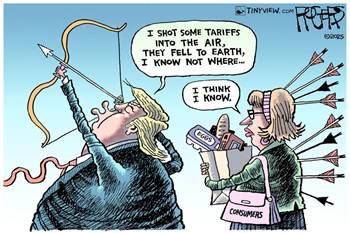
NOT EVEN A LITTLE BIT!

I DON’T THINK ABOUT AMERICANS’ FINANCIAL SITUATIONNOT EVEN A LITTLE BIT.

The most revealing moments in politics are often not the carefully written speeches or polished campaign ads. They are the unscripted comments that slip out when a politician answers quickly and speaks plainly. Oops! What did I just say? Not even a little bit?

That is why President Donald Trump’s recent statement hit so hard.

When asked whether Americans’ financial struggles were influencing his approach to negotiations with Iran, Trump answered: “Not even a little bit… I don’t think about Americans’ financial situation. I don’t think about anybody. I think about one thing: we cannot let Iran have a nuclear weapon.”

His defenders immediately argued that critics were taking the comment out of context. They say Trump was making a national security argument, not confessing indifference to ordinary Americans. Preventing Iran from obtaining a nuclear weapon, they argue, is more important than temporary economic discomfort.

That explanation may be fair. Context matters, but in this case I believe he is speaking his truth.

Words matter too.

Americans are exhausted. Grocery bills remain high. Rent and housing costs continue to climb. Credit card debt is growing. Families are working longer hours while feeling less secure. In that environment, hearing a president say he does not think about Americans’ financial situation lands badly no matter the intended meaning. As it should!

Leadership is not only about policy decisions. It is also about empathy. People want to believe their leaders understand what life feels like outside Washington. They want to hear that someone in power sees the pressure they are under.

This is not just about Trump. The reaction to his comment exposed something deeper: a growing belief that neither party truly understands ordinary people anymore.

Democrats seized on the statement immediately. Some mocked it online. Others argued Trump had “said the quiet part out loud.” Their criticism was politically predictable, but it also resonated because many Americans already feel disconnected from the political class.

Republicans mostly defended Trump’s intent while admitting the wording was rough. Some argued the media clipped the quote unfairly. Others said presidents sometimes must prioritize security over economics. That is true. National security decisions are rarely simple.

Still, the public frustration did not come from one sentence alone. It came from years of accumulated distrust.

Congress suffers from the same problem. Approval ratings remain consistently low because Americans increasingly see lawmakers as performers rather than problem-solvers. John Thune, Mike Johnson, Chuck Schummer, and Hakeem Jeffries are all actors in a play that has no role for ordinary Americans.

People watch endless partisan fights while basic concerns like affordability, healthcare, wages, and housing are unresolved. Many voters believe politicians spend more time protecting parties, donors, and media narratives than protecting citizens.

Whether that perception is entirely fair no longer matters. In politics, trust shapes reality. 

The danger for both parties is not simply anger. It is resignation. When citizens stop believing anyone in Washington genuinely cares about their daily lives, cynicism replaces participation. People disengage. Institutions weaken. Public trust erodes further. Citizens of America need to stay angry and demand their right to speak out, demand more from these actors, and vote for change even if it is just to change.

Ordinary citizens matter. Our congressman will not hold a town meeting because he does not want to hear points of view that differ from his own. So he ignores his constituents! Political disengagement thrives when people begin to believe their voices no longer matter, that government is too corrupt, too polarized, or to engaged in foreign policy matters to respond.

The most effective antidote is consistent civic participation at the local level, where ordinary citizens still have measurable influence. Voting in every election—not just presidential races—matters, but so does attending school board meetings, city council sessions, and town halls where decisions directly affect daily life. Citizens can organize around specific issues, support independent journalism, pressure elected officials through coordinated calls and public testimony, and build community groups that reconnect neighbors across political divides.

Democracy weakens when people retreat into cynicism and passive outrage online; it strengthens when citizens treat civic engagement as an ongoing responsibility rather than a once-every-four-years event. The reality is that disengagement benefits entrenched power, while participation—even imperfect participation—forces accountability.

Americans also need to hear something simple from their leaders: “We see what you are going through.”

T. Michael Smith

wwwtmichaelsmith.com

Endless Wars!

THE HIDDEN COSTS FOR AMERICANS

Americans are trained to fear dramatic catastrophes: Pearl Harbor, 9/11, a sudden invasion, a market crash. But the greater danger to the United States may be quieter and slower. It is not one decisive war. It is being drawn into a long era of interconnected conflicts with no clear victory, no honest withdrawal plan, and no public consent equal to the cost. An endless war.

Look around. Europe remains locked in war over Ukraine. The Middle East cycles through crises that threaten to widen by the month. The US and Israel are at war with IRAN and Hezbollah. Tensions in the Pacific simmer around Taiwan and maritime power. Cyberattacks, proxy militias, sabotage, sanctions, and disinformation campaigns now blur the line between war and peace. None of these theaters exist in isolation. Each affects the others through oil prices, alliances, military stockpiles, shipping lanes, and political attention.

This is how powerful nations become trapped—not by one wrong decision, but by dozens of “limited” commitments that accumulate into permanent strain.

The first casualty is clarity. What does victory mean in these conflicts? Is it regime change? Deterrence? Territorial restoration? Stability? Containment? Humanitarian relief? Too often Washington speaks in slogans while avoiding measurable goals. If leaders cannot define success, the public should assume they are preparing for endless management rather than resolution.

The second casualty is the American household. Every prolonged global confrontation has domestic costs. Defense budgets rise. Interest payments are growing. Infrastructure waits. Housing remains unaffordable. Healthcare costs climb. Schools strain. Citizens are told there is always money for emergency deployments but never enough for ordinary life. (Understanding the Price of War on American Budgets, 04/07/2026, wwwtmichaelsmith.com).  That contradiction breeds cynicism, and cynicism is poison to democracy.

The numbers are not abstract. The United States has spent over $8 trillion on the wars in Iraq and Afghanistan and their aftermath when including long-term obligations like veterans’ care and interest on the debt. Annual defense spending now exceeds $850 billion per year, rivaling Cold War peaks without a single declared, all-encompassing conflict. Support for Ukraine alone has already surpassed $100 billion, with additional commitments likely. (Reuters.org).

And the meter is still running. The Pentagon faces hundreds of billions more to replenish weapons stockpiles sent abroad, for instance. Veterans’ care for post-9/11 service members is projected to cost another $2–three trillion in the decades ahead. Meanwhile, rising interest payments on the national debt—fueled in part by war borrowing—are now approaching $1 trillion annually. (Reuters.org)

That $8 trillion is enough to write a check for $24,000 to every man, woman, and child in America—and still have money left over. Instead, it has disappeared into wars that never clearly ended. Endless wars.

These are not distant accounting figures. They show up as higher borrowing costs, slower wage growth, deferred infrastructure, and an economy more vulnerable to shocks from global instability—especially energy and supply chains.

Put plainly: war spending does not end when the fighting slows. It compounds. The bill arrives slowly, then all at once—and it is paid not just in dollars, but in deferred opportunity.

The third casualty is constitutional culture. Permanent external threats create permanent internal temptations: more secrecy, more surveillance, more executive power, less tolerance for dissent. Criticism is reframed as weakness. Debate is treated as disloyalty. Fear becomes a governing tool.

None of this means America should retreat from the world or abandon allies. It means seriousness is required. A mature republic distinguishes between vital interests and optional entanglements. It demands clear objectives before commitments. Additionally, it shares burdens with allies instead of carrying every load alone. It uses diplomacy not as surrender, but as strategy.

Most of all, it reminds me that national strength begins at home. A country with crumbling roads, indebted families, declining trust, and political paralysis cannot indefinitely police every crisis abroad.

Empires often imagine they fall in battle. More often they fade through exhaustion from endless wars.

America’s greatest risk is not losing one war. It is normalizing a condition in which warlike crisis never ends, victory is never defined, and the bill is always sent to the future.

The question citizens should ask now is simple: What are we trying to achieve in Iran, how long will it take, and what are we neglecting while we chase it?

If leaders cannot answer plainly, the country is already drifting.

T. Michael Smith

wwwtmichaelsmith.com

CEASEFIRE

The newly brokered ceasefire between the United States and Iran is less a resolution than a pause in a rapidly escalating conflict. It is a two-week truce designed to halt immediate violence, reopen critical shipping lanes like the Strait of Hormuz, and create space for negotiations, not peace. Early signs already show how fragile it is.  Disagreement over whether the deal includes fighting in Lebanon, continued regional strikes, and competing interpretations of the terms all threaten to unravel it before diplomacy can take hold. Iran has signaled it still intends to assert strategic control in the region.  U.S. and allied leaders are scrambling to stabilize global shipping and prevent a wider war. In blunt terms, this ceasefire is not peace, it’s a high-stakes holding pattern where both sides are testing whether de-escalation is possible or simply the prelude to another round of conflict.

T. Michael Smith

wwwtmichaelsmith.com

Understanding the Price of War on American Budgets

WHAT ACTUALLY MATTERS?

The United States has entered another Middle East war with speed, force—and a striking lack of honesty about what it will cost. It is a terrible way to divert attention!

Not just in lives overseas, but in policy choices here at home.

But wars like this do not stay “over there.” They come back—in budgets, in alliances, and in the quiet trade-offs that reshape domestic priorities long after the headlines fade.

A Blank Check Meets a Tight Budget

Washington is already preparing to spend tens—if not hundreds—of billions to sustain military operations against Iran. That money will not magically appear.

It never does.

At the exact moment lawmakers are debating cuts to social programs, including pressure on Medicaid and other safety-net spending, this war opens a fiscal floodgate. The same political voices arguing that the country “cannot afford” healthcare expansion or poverty reduction somehow find limitless flexibility when it comes to war.

That contradiction isn’t new—but it is becoming harder to ignore. Listen people!! Do we want healthcare, education and poverty reduction or do we want WAR?

Every missile fired, every deployment extended, is a policy choice. And those choices are being made alongside proposals to constrain domestic investment in housing, healthcare, and economic stability.

You can call it national security. But it is also resource allocation. And right now, the balance is shifting—again—away from Americans at home.

Inflation, Energy, and the Hidden Tax of War

If Congress doesn’t make you feel the cost directly, the economy will.

As tensions disrupt oil flows through the Strait of Hormuz, global energy markets tighten. Prices rise. Supply chains strain.

For American families, that translates quickly:

  • Rising grocery bills
  • Increased borrowing costs
  • Higher Gas Prices

This is the hidden tax of war—one that doesn’t require a vote in Congress but lands just as forcefully in household budgets.

And it comes at a moment when affordability is already one of the central economic pressures in American life.

Executive Power, War Powers, and Accountability

There is also a constitutional cost.

The decision to engage in large-scale military action has once again stretched the limits of executive authority. Congress, constitutionally tasked with declaring war, has largely been sidelined.

This is not just a procedural concern. It is a democratic one.

When wars begin without clear authorization or sustained debate, accountability erodes. Objectives remain vague. Timelines blur. And the public is left reacting to events rather than shaping them.

If this conflict expands—and history suggests it might—the absence of clear legislative grounding will become more than a footnote. It will be a fault line. And we will have yet another mess.

NATO and the Strain on Alliances

Then there is the question of allies.

The North Atlantic Treaty Organization was built on the idea of collective defense and shared strategic purpose. But this war is testing that unity.

Some NATO members have offered support. Others are wary, concerned about escalation, legality, and the long-term consequences of another open-ended conflict in the Middle East.

That hesitation matters.

Because alliances are not just about military capability; they are about trust. When major actions are taken without broad alignment, that trust frays. And once frayed, it is difficult to rebuild.

At a time when global stability depends on coordinated responses—to Russia, to China, to economic shocks—a divided NATO is a strategic liability.

A Government of Trade-Offs

This is the part leaders rarely say out loud:

Government is a system of trade-offs.

You cannot simultaneously argue that:

  • The deficit demands restraint at home
  • Social programs must be cut or capped
  • And war spending should expand without limit

Those positions are not fiscally coherent. They are politically convenient.

The reality is simpler and harder: prioritizing war means deprioritizing something else. And historically, that “something else” has often been domestic investment in the very systems that make economic stability possible.

The Pattern Repeats

From the Vietnam War to the Iraq War, the United States has followed a familiar pattern: enter quickly, escalate decisively, and only later confront the full scope of the consequences.

What makes this moment different is not the pattern—but the context.

The country is more economically divided. Politically polarized. Institutionally strained.

And yet, once again, it is committing to a conflict that demands long-term focus, resources, and unity—without clearly securing any of them first.

The Question That Still Has No Answer

What is the endgame?

Not the immediate objective of weakening Iran. The actual outcome that defines success.

Without that answer, everything else—military gains, political messaging, even alliance management—rests on unstable ground.

And without that clarity, the risk is not just that the war expands abroad.

It’s that its consequences deepen at home—reshaping budgets, alliances, and democratic accountability in ways that will last far longer than the conflict itself. It is up to us dear friends to facilitate change now!

T. Michael Smith

wwwtmichaelsmith.com

Unpacking Trump’s Corruption

This Massive Corruption Isn’t Subtle

In any functioning democracy, corruption is supposed to be the exception, a scandal that shocks the system and triggers accountability. But under Donald Trump, the concern is not about isolated misconduct. It’s about a pattern—one so consistent, so normalized, that it looks less like deviation and more like design.

Start with the most visible layer: the blending of public power and private profit. During his presidency, Trump has refused to fully divest from the Trump Organization, an unprecedented move in modern American politics. Foreign governments, lobbyists, and political allies frequently spend money at Trump-owned properties. These are not abstract ethics debates—they are questions about whether U.S. policy could be influenced by who booked a ballroom or a hotel suite. Several litigants alleged that President Trump’s retention of certain business and financial interests violates the Foreign and Domestic Emoluments Clauses. The Supreme Court ultimately found these cases moot without addressing their merits.

CRYPTO

The pattern has evolved with new financial tools as well. Trump and his allies have increasingly intersected with the world of cryptocurrency—including the promotion of NFT collections like the Trump Digital Trading Cards and fundraising efforts tied to crypto-friendly donors and platforms. While not illegal on its face, this raises fresh transparency concerns: crypto transactions can obscure donor identities, making it harder to trace influence. Critics argue that this creates a modern workaround to campaign finance norms. Money can flow with fewer disclosure requirements and less public scrutiny.

CONVICTION FOR FRAUD

Then there are the legal cases. The Trump Organization criminal trial resulted in convictions for tax fraud, exposing years of financial manipulation inside Trump’s business empire. In civil court, a New York judge found Trump liable for fraud in a sweeping case brought by Letitia James. The judge found that asset values were routinely inflated to secure loans and deflated to reduce taxes. These findings didn’t emerge from partisan talking points—they came from courts applying evidence and law. The New York Appellate Division overturned the $500 million penalty, ruling the disgorgement was an excessive fine that violates the Eighth Amendment. The five-member panel all upheld findings that Trump and his company were liable, affirming that James acted within her authority and that injunctive relief to curb Trump Organization practices was appropriate. Subsequently, Trump had his DOJ indict James for mortgage fraud. The case was dismissed.

LACK OF CONSEQUENCES

And yet, what makes this era distinct is not just the allegations or even the legal outcomes—it’s the erosion of consequences. Despite indictments, civil judgments, and ongoing investigations, Trump has maintained his political standing, although his poll numbers continue to decline. That reality raises a deeper concern: when accountability mechanisms fail to deter, what remains of the rule of law?

Supporters argue that Trump is the target of politically motivated prosecutions, a victim of what they see as a weaponized justice system. That claim resonates in a polarized country where trust in institutions has sharply declined. But the counterargument is just as stark: if overwhelming evidence, court rulings, and documented conduct cannot establish a shared baseline of reality, then corruption becomes not just tolerated, but partisan. Plus, Trump is using the judicial system to target his enemies.

This is the real danger. Corruption in the Trump era isn’t only about one man—it’s about whether democratic institutions can enforce ethical boundaries when those boundaries are systematically tested. If the answer is no, then the precedent extends far beyond Trump himself. Because once corruption is normalized, it doesn’t stay contained. It becomes the blueprint.

Conclusion: The System Under Strain

What makes this moment dangerous is not just the volume of allegations or even the seriousness of individual cases. It is the cumulative stress placed on democratic guardrails. Corruption, when repeated often enough without decisive consequence, stops looking like corruption at all. It becomes reframed as strategy, dismissed as politics, or absorbed into partisan identity.

Under Donald Trump, the traditional mechanisms of accountability—courts, elections, congressional oversight, and public opinion—have all been tested simultaneously. Courts have issued rulings, yet enforcement can be slow and politically fraught. Elections have served as a form of accountability, yet false narratives about their legitimacy have weakened their authority. Congressional oversight has often fractured along party lines, limiting its ability to function as a neutral check. And public opinion, once a stabilizing force, has hardened into camps that interpret the same facts in fundamentally different ways.

The deeper issue, then, is not whether any single act crosses a legal threshold. It’s whether the system can still produce a shared understanding of wrongdoing—and act on it. If one side views investigations as justice while the other sees persecution, accountability itself becomes unstable.

This is where newer mechanisms—like opaque financial channels in cryptocurrency or self-reinforcing media ecosystems—compound the problem. They don’t just enable potential misconduct; they make it harder to detect, prove, and build consensus around. Corruption thrives not only in secrecy, but in confusion.

History suggests that democratic erosion rarely happens in a single dramatic collapse. It happens gradually, as norms weaken, lines blur, and each new breach becomes easier to justify than the last. The risk is not simply that one leader tests the limits—it’s that those tests redraw the limits for everyone who follows.

If there is a path forward, it lies in reasserting that the rule of law is not situational, and that transparency is not optional. That requires more than legal outcomes—it requires institutional courage, political will, and a public unwilling to normalize what once would have been disqualifying.

Because once corruption is no longer disqualifying, democracy itself is no longer self-sustaining.

T. Michael Smith

wwwtmichaelsmith.com

The Surfacing of the Epstein Files

Is The Iran War A Way To Divert Attention From Epstein?

The resurfacing of documents related to Jeffrey Epstein is not simply a lurid footnote in America’s tabloid history. It is a stress test for our institutions — our courts, our political system, our media, and our collective moral courage. The question is no longer whether Epstein committed monstrous crimes. That has been established. The question is whether the powerful networks that enabled him will ever face meaningful scrutiny.

Epstein’s crimes were not hidden in some dark, unreachable corner of society. They unfolded in plain sight, in elite circles that intersected with politics, finance, academia, and royalty. For years, rumors circulated, settlements were sealed, investigations stalled, and consequences evaporated. When Epstein died in federal custody in 2019, the public was left with a combination of outrage and suspicion — not only about the failures that led to his death, but about whether the full story would ever come to light.

The resurfacing of court documents, flight logs, depositions, and investigative materials has revived that unresolved tension. Transparency advocates argue that sunlight is essential: victims deserve acknowledgment, and the public deserves clarity about who knew what — and when. But transparency must be careful, precise, and responsible. A name appearing in a document is not the same as evidence of criminal conduct. The rush to speculate, particularly in a social media ecosystem built on outrage, risks undermining the very accountability people claim to demand.

Still, the broader issue is undeniable: Epstein thrived because systems failed.

He secured a controversial federal plea deal in 2008 that allowed him to serve minimal jail time despite serious charges involving minors. That deal, later widely criticized, signaled something corrosive — that wealth and influence could bend the arc of justice. Prosecutorial discretion, normally a routine function of the justice system, became a symbol of two-tiered accountability.

When institutions appear to shield the powerful, public trust erodes. And once trust erodes, conspiracy fills the vacuum.

The Epstein case has become a magnet for both legitimate investigative journalism and unfounded speculation. That duality reflects a deeper crisis in American civic life. On one hand, citizens rightly demand transparency when elites are implicated in wrongdoing. On the other hand, political actors have weaponized the case to score partisan points, often implying guilt without evidence or using it to feed broader narratives about corruption without substantiation.

The danger is not just misinformation. It is selective outrage.

Accountability must be consistent to be credible. If the surfacing of files reveals institutional failures, prosecutorial errors, or deliberate obstruction, those findings should be pursued wherever they lead — regardless of party, profession, or social status. Justice cannot be calibrated by political convenience. Nor should it become a tool for factional warfare.

Pam Bondi, the Attorney General, has faced mounting pressure over the Justice Department’s handling of records connected to Jeffrey Epstein. Critics argue that Bondi’s resistance to releasing certain investigative files — citing ongoing prosecutions, privacy protections for victims, and national security concerns — has led to deepening public distrust in institutions already strained by years of secrecy and conspiracy. In a political climate where transparency has become synonymous with accountability, Bondi’s posture has fueled suspicions that powerful names or embarrassing institutional failures remain shielded from scrutiny, turning what could be a methodical legal process into a broader test of the Justice Department’s credibility.

At the same time, we must recognize the human core of this story: the victims. Too often, public discourse centers on the famous names rumored to be associated with Epstein rather than on the young women who were exploited. The legal battles over document release and redaction are not abstract transparency debates; they are bound up with privacy concerns, trauma, and the right of survivors to control their own narratives.

True accountability means caring about those victims, not using them as collateral in a political spectacle.

The surfacing of the Epstein files also exposes how power operates in America. Influence is not always about explicit criminal conspiracies. It is often about access, social insulation, and the quiet reluctance of institutions to challenge those at the top. When prosecutors hesitate, when regulators defer, when universities accept donations without scrutiny, and when media outlets soft-pedal uncomfortable stories, a culture of impunity takes root.

If there is any constructive path forward, it lies in structural reform rather than personality-driven outrage. That means stricter oversight of prosecutorial plea agreements in high-profile cases. It means stronger protection for whistleblowers. It means clearer transparency standards for sealed federal records

The public’s appetite for answers is understandable. But the demand must be disciplined. Investigations should be evidence-based. Media coverage should distinguish clearly between documented facts and allegations. Political leaders should resist the temptation to exploit uncertainty for partisan advantage.

The joint military operation with Israel has moved Epstein off the front pages. But I do not believe the American people will lose their quest for answers. The elites worry about reputation, but the people identify more so with the victims of this horrendous episode in American life.

The surfacing of the Epstein files is not just about revisiting the sins of one disgraced financier. It is about whether American institutions can withstand scrutiny and emerge stronger.

Epstein’s crimes revealed moral rot in elite spaces. What happens next will reveal whether our democracy still possesses the will to confront that rot honestly.

T Michael Smith

wwwtmichaelsmith.com

The Normalization of White Nationalism

White Nationalism Walked Through the Front Door

White nationalism didn’t storm the gates of American democracy wearing hoods and waving torches. It walked in through the front door, badge clipped to a suit jacket, armed with talking points, legal memos, and a talent for laundering extremism into “policy.”

Its most effective practitioner is Stephen Miller.

For years, Washington treated Miller as merely a “hardliner,” a technocrat with strong views on immigration. That euphemism did the country enormous harm. Miller is not just tough on borders; he is the clearest example of how white nationalist ideology has been translated into federal governance—quietly, relentlessly, and with devastating human consequences.

This is not a matter of tone or style. It is about outcomes, intent, and ideology.

White nationalism, in its modern form, does not require explicit racial language. It advances the idea that the United States is fundamentally a white, European-descended nation whose survival depends on limiting the presence and power of people deemed “foreign,” especially those who are not white. Its core fear is demographic change. Its core strategy is exclusion.

Stephen Miller built policy around that fear.

From the first days of the Trump administration, Miller framed immigration not as a social or economic question, but as an existential threat—an “invasion,” a “flood,” a crisis engineered by outsiders to overwhelm the nation. This language was not incidental. It echoed the same rhetoric used in white nationalist propaganda for decades, recasting migrants as a hostile force rather than human beings.

Once you accept that framing, cruelty becomes policy.

Family separation was not an unfortunate byproduct of enforcement. It was the point. Miller himself pushed it as a deterrent, fully aware that it would traumatize children and parents alike. Refugee admissions were slashed to the lowest levels since the modern program began. Muslim-majority countries were singled out for bans under the pretense of “security.” Legal immigration pathways that disproportionately benefited non-European migrants were narrowed or dismantled.

Race was never mentioned. Racial hierarchy was enforced anyway.

Defenders still insist this was about “the law.” But the law has always allowed discretion—about whom to prioritize, whom to protect, whom to welcome. Miller’s discretion was consistently exercised in one direction: fewer Black and brown immigrants, fewer Muslims, fewer refugees, fewer poor people. More barriers. More suffering. More exclusion.

And then there is the paper trail.

Investigative reporting revealed Miller’s extensive private correspondence promoting white nationalist websites, extremist authors, and the infamous novel The Camp of the Saints—a book revered in neo-Nazi circles for its fantasy of violent resistance to nonwhite immigrants. These were not stray links or academic curiosities. They were ideological touchstones. Civil rights organizations did not mince words: this was the worldview of someone sympathetic to white nationalism, now shaping national policy.

What makes Miller uniquely dangerous is not just what he believed, but how competently he operated it.

This is the evolution of extremism in a mature democracy. It does not shout slurs. It drafts regulations. It does not riot. It litigates. It learns the language of courts, process, and precedent, using them as shields while advancing fundamentally anti-democratic goals.

The Trump administration provided the vehicle, but Miller provided the roadmap.

And here is the uncomfortable truth Democrats and the media must confront: much of this agenda survived because it was treated as a normal policy dispute rather than an ideological threat. “Border security” debates crowded out moral clarity. The press obsessed over Trump’s chaos while Miller quietly engineered durable damage inside the administrative state.

Courts blocked some of the worst abuses. They did not uproot the ideology. Nor did Congress meaningfully hold its architects accountable.

That failure matters now.

Because white nationalist politics does not disappear when an election ends. It waits. It refines. It looks forward to the next opening. The lesson of Stephen Miller is that democracy can be hollowed out not only by demagogues, but by bureaucrats who understand how to bend institutions toward exclusion without ever openly defying them.

This is not partisan excess. It is democratic self-defense.

If the United States is serious about being a multiracial democracy governed by the rule of law, then it must reject the lie at the heart of Miller’s project: that cruelty preserves the nation, that diversity is decay, that belonging must be rationed by race and origin.

Stephen Miller did not just influence immigration policy. He demonstrated how white nationalism can be made respectable—and how urgently it must be confronted, named, and defeated.

Call to Action

The lesson of Stephen Miller is not simply that one extremist gained power. It is that American institutions were willing to normalize white nationalist governance as a legitimate policy position so long as it was expressed politely and wrapped in legal language.

That cannot continue.

Democrats must stop treating immigration cruelty as a matter of “messaging” and start naming it for what it is: an assault on multiracial democracy. Congressional oversight should not be symbolic. It should be aggressive, sustained, and aimed squarely at the architects of these policies, not just their most visible mouthpieces. The administrative state must be rebuilt with safeguards that prevent ideological extremism from being laundered into regulation.

The media, too, must abandon its addiction to euphemism. There is a moral difference between policy disagreement and racial exclusion. When journalists describe white nationalist outcomes as “hardline” or “controversial,” they obscure the truth and protect the powerful from accountability.

And the public cannot look away. White nationalism does not announce itself with banners. It advances through apathy, exhaustion, and the false belief that “it can’t happen here.” It already has.

Stephen Miller’s legacy is a warning. If his ideas remain viable inside mainstream politics, then the problem is larger than one man. It is a test of whether American democracy is willing to defend itself—not just from overt authoritarians, but from the quieter, more disciplined extremists who know how to work the system from within.

Democracy survives only when it draws lines—and enforces them. Now is the time to do both.

T. Michael Smith

wwwtmichaelsmith.com

HOW MANY DEATHS WILL IT TAKE

UNTIL ICE JUST MELTS AWAY?

A protestor in Minneapolis, one of thousands demanding that ICE end its violent occupation of the city and its abuse of immigrants and people of color, carried a simple message: Americans in 2026 still believe in the nation’s founding principles of equality and the rule of law. That belief—not chaos, not extremism—is what now fills the streets.

What is happening in Minneapolis is not a rebellion against law. It is a rebellion against lawlessness by the federal government.

When federal immigration agents shoot and kill residents during opaque enforcement operations—and then shield themselves behind jurisdictional fog, immunity doctrines, and bureaucratic delay—the problem is not protest. The problem is power without accountability, exercised by agencies overseen by Department of Homeland Security Secretary Kristi Noem and defended by a Justice Department now led by Attorney General Pam Bondi.

The killings of Renée Good and Alex Pretti did not spark unrest because Americans suddenly became radicalized. They sparked unrest because they laid bare a system in which armed federal agents operate inside U.S. cities with fewer checks than local police, weaker transparency requirements, and near-automatic protection from meaningful consequence. Minneapolis did not radicalize the country. ICE did—under leadership that has explicitly framed immigration enforcement as a show of force rather than a civil function bound by constitutional restraint.

The public response has been swift and unmistakable. Thousands marched through sub-zero streets not merely to grieve but to insist that constitutional rights do not end at the border—or at the badge of a federal agency. Protesters invoked the First Amendment, due process, equal protection, and the most basic democratic demand: if the government kills, the government must answer.

So far, that answer has been partial at best.

Under Attorney General Pam Bondi, the Department of Justice has opened a federal civil-rights investigation into the killing of Alex Pretti. That decision matters. It signals that the use of deadly force by federal agents is not automatically immune from scrutiny. But it also exposes a troubling inconsistency: no comparable investigation has been opened into the killing of Renée Good. Two deaths. One investigation. One silence.

That selectivity is not merely procedural. It is political.

Bondi’s DOJ has emphasized federal authority and jurisdictional limits while declining to explain why one killing triggers civil-rights review and another does not. At the same time, DHS—answerable to Secretary Noem—has resisted broader transparency, forcing courts to intervene simply to ensure that evidence is preserved. Accountability has not been embraced; it has been extracted under pressure.

The legal deck is stacked. Criminal prosecutions of federal officers face extraordinarily high barriers. Prosecutors must prove not only that deadly force was excessive, but that it was willfully unlawful. The Supremacy Clause allows federal agents to claim immunity from state prosecution so long as they assert they were acting within their official duties. In practice, that doctrine has become a near-automatic shield, transforming federal authority into federal insulation.

Minnesota Governor Tim Walz has demanded cooperation and accountability, while Minneapolis officials have questioned why their city is being subjected to a level of federal force more commonly associated with counterterrorism than civil immigration enforcement. Members of Congress, including Representative Pramila Jayapal and other House Judiciary Committee Democrats, are now pressing Bondi’s Justice Department to explain its selective approach to civil-rights enforcement.

Even some Republicans have voiced concern, warning that unchecked federal policing undermines public trust. That bipartisan unease underscores a central truth: this is no longer simply a debate about immigration policy. It is a debate about democratic control over armed federal power.

Civil rights groups, including the ACLU, have filed lawsuits alleging racial profiling, warrantless stops, and unconstitutional conduct by ICE and Border Patrol agents operating in Minneapolis. Yet recent Supreme Court decisions narrowing claims mean that even when constitutional violations occur, victims’ families may be left without meaningful recourse. Accountability, once again, is delayed—if it arrives at all.

This accountability crisis did not arise in a vacuum. It has been engineered, in part, by a Supreme Court that has steadily narrowed the ability of ordinary people to hold federal officials accountable for constitutional violations. In decisions written or joined by justices such as Clarence Thomas, Samuel Alito, and John Roberts, the Court has aggressively restricted claims, effectively telling victims of federal abuse that even clear violations of rights may have no remedy in court. The message has been unmistakable: federal officers can violate constitutional protections, but the courthouse doors may be closed. That judicial retreat from accountability now plays out on the streets of Minneapolis, where families are told to trust internal investigations instead of independent courts. A Constitution without enforceable remedies is not a shield, it is a suggestion. And when the Supreme Court treats accountability as optional, federal agencies learn to do the same.

Critics argue that protests like those in Minneapolis undermine order. The opposite is true. What undermines order is an enforcement regime that treats constitutional safeguards as optional, deploys militarized agents into civilian neighborhoods, and responds to public outrage with selective investigation and legal maneuvering.

The protesters are not rejecting American ideals. They are insisting that those ideals apply to everyone, including ICE Acting Director Todd Lyons, the agents he commands, and the Justice Department that decides when federal power will be restrained and when it will not.

This moment exposes a deeper truth: ICE has become an agency structurally insulated from democratic accountability. It operates across jurisdictions, blurs the line between civil enforcement and criminal policing, and relies on legal doctrines that make oversight rare and consequences rarer still. No democracy can sustain an enforcement apparatus that answers upward to political leadership but never outward to the public.

If citizens of the United States are serious about equality before the law, then accountability cannot depend on discretion exercised behind closed doors at DOJ. It must be automatic, independent, and uniform. That means mandatory federal review of all fatal uses of force by federal agents, full cooperation with state investigations, enforceable transparency standards, and consequences not just for individual officers—but for leadership failures at DHS and DOJ alike.

Minneapolis is not rejecting America. It is reminding the country what America claims to be.

In 2026, the demand echoing through the streets is not radical. It is foundational: no agency, no badge, no attorney general stands above the law. Equality without enforcement is a slogan. The rule of law without accountability is a lie. And the people of Minneapolis are no longer willing to accept either. Abolish DHS!

T. Michael Smith

wwwtmichaelsmith@gmail.com

SURVIVAL IS NOT A THEORY


IT IS A FACT OF EVERYDAY LIFE

Survival is not a theory (Rev Jen Raffensperger- Unitarian Universalist Church of Roanoke). It is not an abstract concept relegated to think-tank reports or academic debates. It is lived in real time by mothers dropping their kids off at school, by workers juggling multiple jobs to pay rent, and by communities watching federal agents descend into their streets with overwhelming force. In Minneapolis this winter, this basic truth was laid bare with tragic clarity.


When an Immigration and Customs Enforcement agent fatally shot 37-year-old Renée Good during a federal enforcement operation in Minneapolis on January 7, the incident sent shock waves through the city. Good, a U.S. citizen and mother of three, was killed near Portland Avenue South amid a surge of federal agents deployed to carry out immigration actions—part of a larger campaign known locally as “Operation Metro Surge.”


Local leaders and civil rights advocates have raised alarm over the heavy-handed approach. Video and eyewitness accounts contradicted initial federal claims that Good posed an imminent threat, with many describing her as trying to move away from agents when she was shot multiple times. Protests erupted, challenging not just the specific use of force, but the broader role of ICE in communities already burdened by economic insecurity and racial inequity.


This tragedy in Minneapolis illustrates a painful reality: enforcement policies that treat immigration, poverty, and policing as separate challenges ultimately compound trauma for the more vulnerable populations. In neighborhoods where wages lag behind the cost of living and opportunities are scarce, survival is not something people theorize about—it’s something they struggle for every day. Yet when federal and local authorities respond to desperation and informal economies with tactical deployments and steel-toed enforcement, they risk turning survival itself into a criminal act.

ICE’s increased presence in Minneapolis did not happen in a vacuum. Advocates have criticized tactics ranging from expansive surge deployments to controversial detentions of children and parents, raising fears that enforcement has become punitive rather than protective. Another American was killed in Minneapolis, Alex Pretti. ICE agents shot him after wrestling him to the ground.


Policing poverty with force only deepens mistrust. When federal agents operate alongside local police without clear oversight or accountability, the message is chilling: struggle for survival at your own risk. Families scrambling to make ends meet see school attendance drop amid fear of raids. Community members hesitate to seek help, fearful that any interaction with law enforcement could escalate into something worse. And when incidents like Good’s and Pretti’s killing occur, local authorities and residents are left demanding transparency while federal agencies retreat behind outright lies and claims of immunity and jurisdiction.


Survival cannot be secured through deterrence or deterrence by force. Treating migration and poverty as problems to be policed rather than conditions to be addressed only shifts the burden onto people least equipped to bear it. Minneapolis—still scarred by past trauma and divisions—now grapples with the consequences of a system that has chosen militarized enforcement over humane policy.


What Minneapolis needs—and what every community struggling under poverty and immigration stress deserves—is investment in human infrastructure: housing, livable wages, healthcare, schools, and legal pathways that respect dignity. It means disentangling community safety from punitive policing models and rejecting the notion that survival must be negotiated through fear. Courageous cities and countries that have tackled poverty with social programs rather than handcuffs have seen crime and instability decrease, not increase.


Survival is not a theory. It is the most basic affirmation of human dignity. Any society that treats it as optional or negotiable, that responds to hardship with militarized force, has already failed the people it professes to serve. Our response to tragedy—whether in Minneapolis or communities nationwide—must be rooted in justice, accountability, and a recognition that people’s lives are not collateral in a political strategy.


T. Michael Smith
wwwtmichaelsmith.com