Highest Use of Politics Is to Enrich Yourself!!
The THEORY of HONEST GRAFT holds that a politician can serve the public while profiting from their service at the same time. This “Theory” pops up regularly with the Trump family.
Recent reporting has connected several separate stories into a broader discussion about potential conflicts of interest surrounding President Trump’s finances. The key issues involve his financial disclosure, cryptocurrency ventures, the pardon of Binance founder Changpeng Zhao, and investments tied to critical minerals.
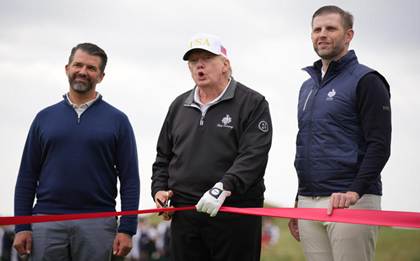
(The Trump Boys)
Trump’s 2025 Financial Disclosure
The recently released 927-page financial disclosure shows that Trump earned exceptionally large sums from cryptocurrency-related businesses, reportedly exceeding $1.4 billion during the reporting period. The largest sources include: World Liberty Financial, The $TRUMP memecoin, and licensing and crypto-related investments. In January 2025, the $Trump memecoin skyrocketed to an all-time high of $75.35. However, it has since experienced a massive decline, trading between $1.60 and $1.70 per coin currently.
The disclosure represents a major shift from Trump’s previous wealth, which had been concentrated in real estate, hotels, and golf properties. Crypto has become one of the largest components of his reported income. (The Daily Beast)
Binance and Changpeng Zhao
Binance pleaded guilty in 2023 to violating U.S. anti-money laundering and sanctions laws. Its founder, Changpeng Zhao (“CZ”), also pleaded guilty to violating the Bank Secrecy Act and served four months in federal prison before later receiving a presidential pardon from Trump in 2025. (Wikipedia)
The issue became controversial because: Binance reportedly pursued business relationships with Trump-affiliated crypto ventures, World Liberty Financial later entered arrangements involving Binance’s ecosystem, and Trump subsequently pardoned Zhao.
Critics argue this creates the likelihood of a conflict of interest, while supporters argue the pardon reflected the administration’s broader pro-cryptocurrency philosophy rather than any business relationship. Those competing interpretations remain central to the debate. (Wikipedia)
World Liberty Financial
World Liberty Financial is the Trump family’s cryptocurrency venture.
The company has: sold digital tokens, launched the USD1 stablecoin, partnered with firms throughout the crypto industry, and attracted investments from foreign entities. Legal scholars and ethics experts have questioned whether foreign investments into businesses closely tied to a sitting president create constitutional or ethical concerns, particularly regarding the Constitution’s Emoluments Clause. Supporters counter that Trump’s assets are managed through family-controlled structures and that no laws have been violated. (Wikipedia)
Critical Minerals and MP Materials
MP Materials is America’s leading producer of rare earth materials, which are considered critical minerals because they are essential for: electric vehicles, military equipment, semiconductors, and renewable energy technologies.
The Trump administration has strongly supported expanding domestic critical mineral production to reduce dependence on China. MP has been a beneficiary. Is this Honest Graft?
For years, conservatives warned that government should never pick winners and losers. Markets, they argued, reward innovation. Bureaucrats reward political connections. Government ownership of private enterprise was denounced as socialism. Industrial policy was ridiculed. Corporate subsidies were condemned.
Then came the Trump administration’s critical minerals strategy.
Today, billions of taxpayer dollars are being directed into companies producing rare earth elements and other strategic materials. The federal government is providing loans, guaranteeing purchases, taking ownership stakes, and helping finance new processing facilities in the name of national security. The justification is reducing America’s dependence on China—a legitimate and important objective. The method, however, deserves far greater scrutiny.
No one disputes that China dominates the global supply chain for rare earths and many critical minerals. America should develop domestic alternatives. But protecting national security does not require abandoning accountability.
The danger is not the goal. The danger is the concentration of extraordinary financial power in the hands of political leaders who decide which private companies (MP Materials) receive extraordinary public support.
Every administration posits that its decisions are guided by the national interest. Every administration promises transparency. Yet history repeatedly shows that whenever government begins directing billions into selected industries, lobbying expands, influence grows, and access to politicians becomes a valuable business asset.
Washington stops being merely the referee. It becomes the venture capitalist. And that is very dangerous! Bureaucrats have no idea what private equity is, much less how to invest in it!
That should concern Americans regardless of party.
When the government acquires ownership interests in private firms, taxpayers become involuntary investors—but without the rights that normally accompany investment. Citizens cannot vote on corporate strategy. They cannot examine negotiations. Nor can they choose where their money goes. Citizens assume the financial risk while political leaders claim the credit. If it works!
The administration insists these investments are essential to compete with China. Perhaps they are. But if defeating state-directed capitalism requires America to adopt its own version of state-directed capitalism, then citizens deserve an honest debate about what is being built.
Even more troubling are the ethical questions that inevitably arise when politically connected businesses operate in sectors receiving massive federal support. Whether or not any laws are broken, the appearance of overlapping political influence and private financial opportunity damages our country and its people. No one wants think their country is corrupt. Democracy depends not only on honest government but on government that appears beyond reproach. The perception that influence can open doors closed to everyone else is corrosive. It convinces ordinary citizens that there are two economic systems in America: one governed by competition, another by connections. That perception is as damaging as actual corruption.
The same political movement that once condemned industrial subsidies is now embracing one of the most aggressive government-directed investment strategies in generations. The same voices that criticized government intervention now celebrate Washington taking ownership stakes in private companies. Principles that were once presented as fundamental suddenly become flexible when political power changes hands.
If this policy truly serves the national interest, it should withstand the highest level of public scrutiny. Publish every selection criterion. Require independent ethics reviews. Strengthen conflict-of-interest rules. Subject every dollar to rigorous oversight.
National security should never become a phrase that discourages questions. It should demand even greater transparency because extraordinary powers require extraordinary accountability.
The United States does need resilient supply chains. It does need domestic mining, processing, and manufacturing. But America has never defined itself solely by what it builds. It has defined itself by how it governs.
If billions in taxpayer money are going to reshape entire industries, Americans deserve confidence that contracts are awarded because companies earned them—not because they knew the right people. Once government begins deciding who receives billions and who receives nothing, every citizen has the right—and the responsibility—to ask whether public policy is serving the nation or rewarding the well connected.
That question is not partisan. It is patriotic.
Why These Stories Are Being Linked
We have connected these developments because they involve four overlapping themes: Personal financial gain through cryptocurrency, Presidential actions affecting the crypto industry, pardon granted to a prominent executive whose company had ties to Trump-related ventures, and government policies that could benefit industries in which Trump family interests reportedly participate.
Whether these circumstances amount to actual corruption is disputed. No court has determined that the disclosed financial relationships themselves constitute criminal conduct. However, ethics experts, watchdog organizations, and some media outlets argue that the combination of private business interests and official presidential actions creates significant conflict-of-interest concerns. The White House has consistently maintained that President Trump acts in the public interest and that his assets are managed in a way intended to avoid conflicts. (Oversight Democrats)
Taken together, the financial disclosure has intensified scrutiny because it provides a more complete picture of how cryptocurrency and investments connected to strategic industries have become central to Trump’s financial portfolio, prompting renewed debate over transparency, ethics, and the separation between public office and private business interests. If we follow the money, we are likely to find corruption. The delegates constructing The Declaration of Independence believed that a nation should not rest on the arbitrary rule of one man and his handpicked advisors, but on the rule of LAW. Indeed!
T. Michael Smith
wwwtmichaelsmith.com
“That question is not partisan. It is patriotic” Yes! What the Trumps are doing would be hilarious if it were in a Gilbert & Sullivan operetta. Here in the real world, it’s wrong wrong wrong.